Agentic Cloud OS: Why Unified Platforms Outperform Fragmented Ones
The Agentic Cloud OS: Why Unified Platforms Outperform Fragmented Stacks
In the evolving world of cloud computing, businesses face the crucial decision of selecting an integrated cloud operating system (OS) like the Agentic Cloud OS or opting for a fragmented stack of disparate solutions. The decision stakes are high: the right choice can streamline operations, enhance productivity, and accelerate innovation. Here, we’ll explore why unified platforms like the Agentic Cloud OS are increasingly preferred over fragmented stacks.
Unified vs. Fragmented: Understanding the Distinction
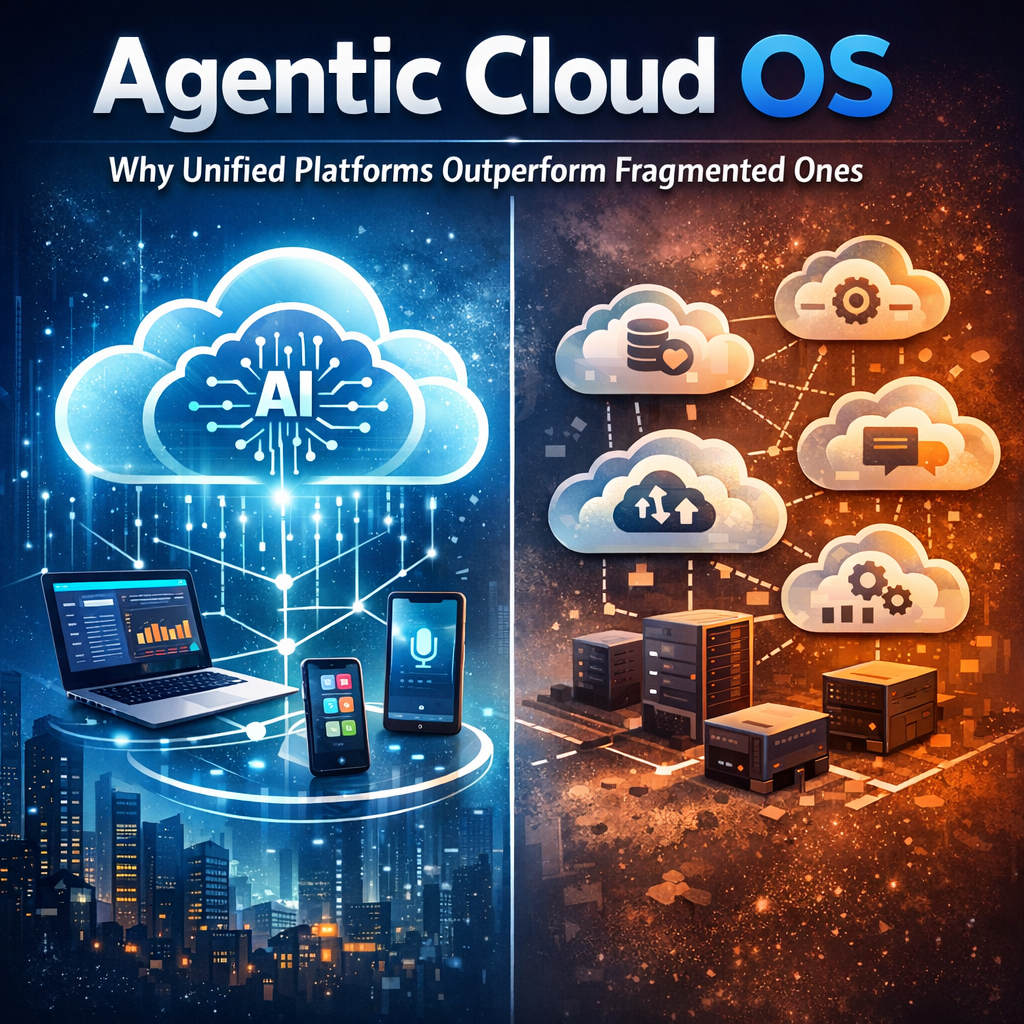
The distinction between unified platforms and fragmented stacks is substantial:

- Unified Platforms: These are comprehensive systems designed to function seamlessly across various aspects of computing, storage, and networking. A unified platform offers an integrated suite of services that work coherently to deliver business solutions.
- Fragmented Stacks: Comprised of solutions from multiple providers, these stacks often require substantial customization and integration effort to work together, which can lead to compatibility issues and increased maintenance.
Enhanced Efficiency and Reduced Complexity
One of the primary advantages of adopting a unified platform like the Agentic Cloud OS is the inherent efficiency it brings. When all parts of a cloud environment are designed to operate in concert, businesses experience:
- Streamlined Operations: With a single platform managing all cloud services, IT teams spend less time on integration and more on innovation.
- Consolidated Management Tools: Unified platforms provide a common dashboard for monitoring and managing resources, which simplifies administrative tasks.
- Reduced Complexity: Fewer systems and interfaces to manage means less room for error, enhancing operational reliability.
Cost-Effective Scaling and Maintenance
As businesses grow, so do their digital infrastructures. Unified platforms inherently support scalable architecture, which allows for growth without the disproportionate increase in complexity and costs. This scalability presents numerous benefits:

- Economies of Scale: Larger, unified systems often reduce per-unit costs of operation.
- Simplified Upgrades: Upgrading a single system is generally less costly and less complex than upgrading multiple fragmented systems.
- Lower Total Cost of Ownership: Integrated platforms can reduce the need for extensive support teams and downtime caused by system incompatibilities.
Enhanced Security Posture
Security is a top priority for any cloud-based operation, and unified platforms often offer superior security frameworks compared to fragmented solutions. With a unified approach:

- Centralized Security Policies: These can be applied uniformly across all services and geographies, reducing the risk of gaps in protection.
- Simplified Compliance: Meeting industry standards and regulations is easier when all data and processes are under one roof.
- Quicker Response to Threats: Integrated platforms can often deploy patches and updates more quickly across the entire system, addressing vulnerabilities more efficiently.
Innovation Through Integrated Ecosystems
Innovation is about speed and efficiency in turning ideas into products or enhancements. Unified cloud platforms, by nature, foster a conducive environment for innovation:
- Rapid Prototyping and Deployment: Integrated services enable developers to quickly build and test new applications.
- AI and Machine Learning Capabilities: Many unified platforms come equipped with advanced analytics tools that can drive better decision-making.
- Enhanced Collaboration: Teams can collaborate more effectively when they are using the same tools and interfaces.
Conclusion
The Agentic Cloud OS exemplifies the superiority of unified platforms over fragmented stacks with its cohesive, efficient, and secure environment that enhances business agility and reduces operational costs. Businesses looking to remain competitive in the fast-paced digital economy would benefit from considering the inherent advantages of such integrated solutions. The ability to innovate rapidly, scale efficiently, and manage seamlessly makes unified platforms, particularly the Agentic Cloud OS, a wise choice for today’s dynamic business needs.