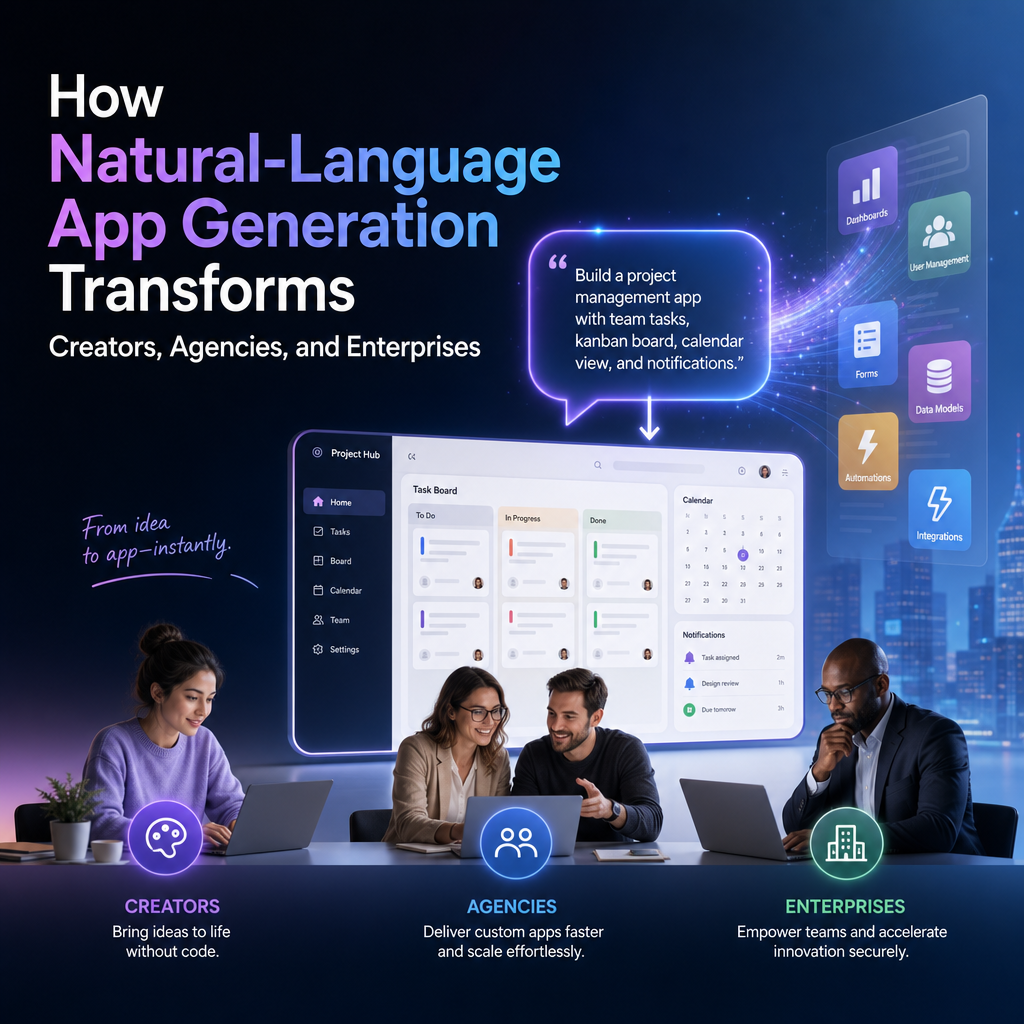
How Natural-Language App Generation Transforms Creators, Agencies, and Enterprises
How Natural-Language App Generation Is Transforming Creators, Agencies, and Enterprises
Software development is entering a new phase. Instead of starting with wireframes, tickets, and long technical specifications, people can now describe what they want in plain English and watch an app take shape. This shift, often called natural-language app generation, is changing who can build software, how quickly teams can launch, and what kinds of digital products become possible.
For creators, agencies, and enterprises, the impact is practical and immediate: faster prototyping, lower barriers to entry, and a new way to turn ideas into usable tools.

What Is Natural-Language App Generation?
At its core, natural-language app generation allows users to create apps by describing features, workflows, and design preferences in everyday language.
Instead of manually coding every screen and function, a user might type something like:

- “Build a client portal with login, file upload, and payment tracking”
- “Create a mobile booking app for a fitness studio”
- “Generate a dashboard that shows weekly sales, leads, and campaign performance”
The system interprets those prompts and converts them into app structure, interface elements, data models, and sometimes even deployment-ready software.

This approach doesn’t eliminate developers. Instead, it changes the development process by making software creation more conversational, iterative, and accessible.
Why It Matters Now
The demand for custom digital tools has exploded.
Businesses need internal dashboards, customer portals, mobile experiences, workflow automations, and branded platforms. At the same time, traditional development remains expensive, time-consuming, and often bottlenecked by limited engineering resources.
Natural-language app generation helps close that gap.
Key advantages include:
- Speed: Teams can go from idea to prototype in hours instead of weeks
- Accessibility: Non-technical users can participate directly in app creation
- Iteration: Changes can be described and applied quickly
- Cost efficiency: Smaller teams can launch tools without large development budgets
As a result, software is becoming something more people can actively shape, not just request.
How Creators Benefit
For independent creators, coaches, educators, and digital entrepreneurs, the biggest challenge is often execution. They may have a strong audience and clear ideas, but limited technical skills or budget.
Natural-language app generation lowers that barrier.
A creator can now build:
- Member portals
- Course companion apps
- Client onboarding flows
- Appointment systems
- Community tools
- Lightweight mobile products
This makes it easier to test ideas before investing heavily. Instead of waiting months for a developer or relying on a patchwork of plugins, creators can launch functional tools faster and refine them based on real feedback.
Just as importantly, they gain more control over the product vision. The distance between the idea and the first working version becomes much smaller.
How Agencies Can Move Faster and Deliver More
Agencies are under constant pressure to deliver quality work quickly while protecting margins. Whether they build marketing tools, client dashboards, microsites, or internal systems, time is a critical factor.
Natural-language app generation can improve agency operations in several ways.
Faster prototyping for client approval
Agencies can turn project briefs into visual, interactive prototypes much earlier in the process. That means fewer misunderstandings and faster sign-off.
Better collaboration between strategy and production
Strategists, account managers, designers, and developers can all participate more directly. When requirements can be expressed in plain language, communication becomes clearer across disciplines.
More scalable service offerings
Agencies can offer custom digital products to smaller clients who may not have the budget for full traditional builds. That opens new revenue opportunities without requiring large increases in production time.
In many cases, agencies won’t replace their developers. They will simply use these tools to eliminate repetitive setup work and focus technical talent on customization, integrations, and performance.
What It Means for Enterprises
Enterprises often face a different challenge: not a lack of ideas, but too many requests and too few resources to fulfill them.
Internal teams need tools for:
- Reporting
- Workflow management
- HR processes
- Procurement
- Field operations
- Customer support
These projects frequently sit in long queues behind larger transformation initiatives. Natural-language app generation helps enterprises create useful internal applications more efficiently and reduce dependency on overloaded engineering teams.
Enterprise-level advantages include:
- Quicker internal tool development
- Faster experimentation with new workflows
- Improved alignment between business teams and IT
- Reduced backlog for simple or repeatable app requests
Of course, large organizations still need governance, security, compliance, and integration with existing systems. But for many use cases, natural-language interfaces can dramatically shorten the path from request to working solution.
The Human Role Is Still Essential
Despite the excitement, natural-language app generation is not a magic replacement for product thinking.
People still need to define goals, understand users, evaluate workflows, and make smart decisions about usability, privacy, and long-term maintenance. A generated app can accelerate building, but it cannot fully replace strategic judgment.
The best results happen when human expertise and AI-assisted generation work together.
That means:
- Creators bring audience insight
- Agencies bring process and design discipline
- Enterprises bring governance and scale
- Developers bring technical depth and customization
In other words, the future is not “AI builds everything alone.” The future is faster creation with humans steering the outcome.
A New Era of Software Creation
Natural-language app generation is reshaping how digital products are conceived and built. It gives creators a way to launch ideas faster, helps agencies improve delivery and profitability, and enables enterprises to respond more quickly to internal software needs.
The biggest transformation may be cultural as much as technical. Software creation is becoming more participatory. More people can describe what they need and see it become real.
That shift opens the door to a broader, more creative, and more responsive app economy—one where building useful software starts with a conversation.