
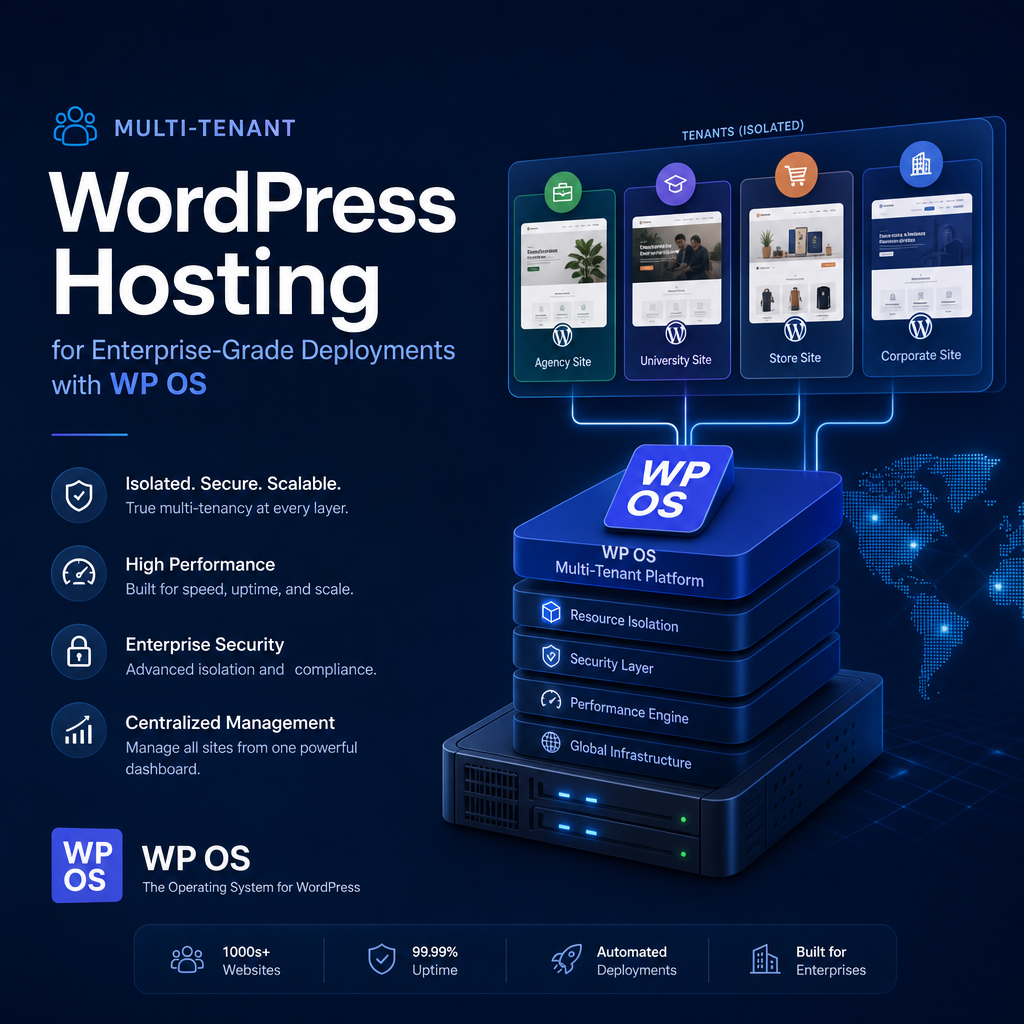
Multi-Tenant WordPress Hosting for Enterprise-Grade Deployments with WP OS
Modern digital teams rarely manage just one WordPress site. Enterprises often run dozens, hundreds, or even thousands of websites across brands, regions, campaigns, and internal business units. That scale exposes the limits of traditional hosting models. Multi-Tenant WordPress Hosting is emerging as a smarter approach, and WP OS is helping redefine what that looks like for enterprise-grade deployments.
Why Traditional WordPress Hosting Breaks at Scale
Most WordPress hosting environments were designed around single-site thinking. Even when providers support multisite or bulk site management, the operational model often stays fragmented.

That creates familiar challenges:
- Repeated setup and provisioning work
- Inconsistent security policies
- Plugin and theme drift across properties
- Slow onboarding for new sites
- Higher infrastructure and maintenance costs
- Limited governance for enterprise teams
For organizations managing a large portfolio of WordPress instances, these inefficiencies add up quickly. What starts as a manageable stack can become a sprawl of duplicated effort and avoidable risk.

What Multi-Tenant WordPress Hosting Really Means
At its core, Multi-Tenant WordPress Hosting allows multiple WordPress sites or environments to run on a shared platform architecture while still maintaining isolation, control, and flexibility for each tenant.

This is not just about packing more sites onto a server. In an enterprise context, it means building a standardized operational layer where teams can:
- Launch sites faster
- Apply centralized policies
- Scale infrastructure predictably
- Maintain tenant-level separation
- Reduce administrative overhead
The real value comes from balancing efficiency with governance. That is where many legacy hosting approaches fall short.
How WP OS Reinvents the Model
WP OS approaches WordPress as an operating platform rather than a collection of standalone installs. That shift matters.
Instead of treating every new site as a separate engineering project, WP OS creates a repeatable framework for deployment, management, and scaling. Enterprises can standardize core infrastructure while still allowing individual sites or business units to operate with the autonomy they need.
Key advantages of the WP OS approach
1. Centralized platform governance
WP OS makes it easier to manage standards across multiple WordPress properties. Security rules, update policies, access controls, and deployment workflows can be applied consistently.
For enterprise teams, that means fewer gaps between sites and a much stronger compliance posture.
2. Faster site provisioning
Launching a new site should not require rebuilding the wheel. WP OS supports templated, repeatable deployments that let organizations spin up new WordPress instances quickly.
This is especially useful for:
- Franchise networks
- Higher education systems
- Media groups
- Multi-brand enterprises
- Agencies serving large client portfolios
3. Resource efficiency at scale
A strong Multi-Tenant WordPress Hosting platform should optimize shared resources without sacrificing reliability. WP OS helps enterprises avoid over-provisioning while still maintaining performance across tenants.
That leads to better infrastructure utilization and more predictable operating costs.
4. Tenant isolation and security
Shared architecture only works when isolation is handled correctly. WP OS is built to support enterprise-grade separation between tenants, reducing the risk that one compromised site or misconfiguration affects the wider environment.
For organizations where security is non-negotiable, this is a critical foundation.
Built for Enterprise Workloads
Enterprise WordPress is not just “more traffic.” It also involves more stakeholders, more approvals, more integrations, and more operational complexity.
WP OS is well-suited for environments that need:
- Role-based access for distributed teams
- Staging and production workflow consistency
- Integration with enterprise DevOps practices
- Scalable deployment pipelines
- High availability and resilience
- Clear oversight across large site portfolios
In other words, it supports the realities of enterprise publishing, not just the basics of web hosting.
Why This Matters for Digital Teams
Marketing, IT, and engineering teams often want different things from a hosting platform.
- Marketing wants speed and flexibility
- IT wants governance and security
- Engineering wants automation and repeatability
- Leadership wants cost control and reduced risk
WP OS helps align those priorities. By rethinking Multi-Tenant WordPress Hosting as a platform strategy, it reduces friction between teams and creates a more sustainable model for growth.
That can translate into faster time to market, fewer manual processes, and a cleaner path for scaling digital operations.
A Better Future for WordPress at Scale
WordPress remains one of the most powerful content platforms in the world, but enterprise success depends on how it is deployed and managed. As organizations expand their site ecosystems, old hosting patterns become harder to defend.
WP OS offers a more modern answer. It brings structure to complexity, governance to scale, and efficiency to large WordPress portfolios. For enterprises that need a secure, repeatable, and high-performing way to run many sites, Multi-Tenant WordPress Hosting is no longer a niche concept. It is becoming the blueprint for what enterprise WordPress should look like next.
Final Thoughts
Enterprise WordPress teams need more than uptime. They need a platform that supports scale, control, and speed at the same time.
WP OS shows how Multi-Tenant WordPress Hosting can evolve from a technical hosting model into a strategic foundation for enterprise digital delivery. For organizations managing large WordPress ecosystems, that reinvention could make all the difference.