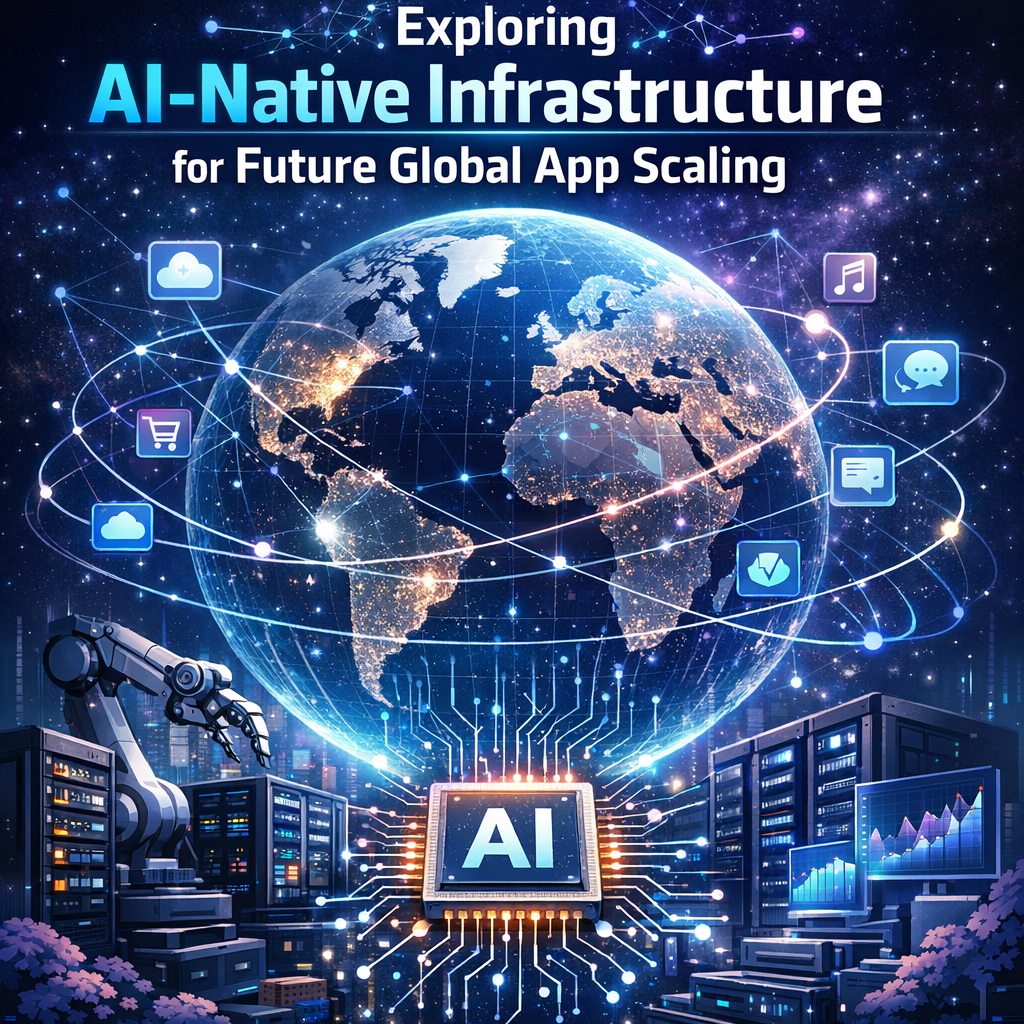
Exploring AI-Native Infrastructure for Future Global App Scaling
Why AI‑Native Infrastructure Is the Future of Global App Scaling
In the ever-evolving landscape of technology, the rise of artificial intelligence (AI) has ushered in a new era of innovation across various sectors. Specifically, in the realm of application development and deployment, AI-native infrastructure is becoming increasingly significant. This advanced technology framework is not just enhancing how applications are built but is also transforming their scalability on a global scale.
Understanding AI-Native Infrastructure

AI-native infrastructure refers to computational environments and ecosystems designed from the ground up to natively support AI functionalities. These infrastructures are intricately engineered to optimize AI processes such as machine learning, deep learning, and neural networks, ensuring that applications can leverage AI capabilities to their fullest potential.

Key Components of AI-Native Infrastructure
-
High-Performance Compute Power
- Scalability and handling complex AI algorithms require robust processing capabilities, which AI-native infrastructures provide.
-
Data Management Systems
- Effective handling and processing of large datasets with high-speed data storage solutions and advanced data pipelines.
-
Network Architecture
- Enhanced connectivity options that support quick data transfer rates essential for real-time AI computations.
-
Integrated AI Tools and APIs
- Pre-built tools and APIs for machine learning, analytics, and more, allowing developers to embed sophisticated AI functionalities easily.
Why AI-Native Is Crucial for Global App Scaling
The global digital market demands that applications not only perform well but also adapt and scale quickly across different regions. AI-native infrastructures are pivotal in achieving this scalability for several reasons:
Enhanced Performance and Efficiency
AI-native systems provide applications the backbone they need to operate efficiently under the stress of large, diverse data sets and high user demand. This is particularly crucial when scaling applications globally, as businesses can leverage AI-driven insights to improve user experience and backend efficiencies, thus driving overall performance.

Real-Time Data Processing
With the expansion into global markets, applications must handle and process data in real-time. AI-native infrastructures support the high-speed analysis and processing capabilities needed for real-time decision making, which is essential for maintaining operational efficiency and customer satisfaction on a global scale.

Cost-Effective Scalability
Traditional scaling methods often involve significant hardware investments and can lead to underutilized resources. AI-native frameworks, with their cloud-based models and resource-efficient architectures, can dynamically adjust resources based on demand, reducing waste and cost.
Continuous Learning and Adaptation
AI-native apps can continuously learn and adapt from new data and interactions, thanks to the underlying AI capabilities. This adaptive scaling is crucial for global applications that need to cater to evolving market trends and consumer behaviors.
Industry Examples of AI-Native Infrastructure Success
1. Streaming Services
- Platforms like Netflix and Spotify use AI-native infrastructures to handle millions of simultaneous streams while recommending personalized content to a global audience.
2. E-commerce
- Giant retailers such as Amazon utilize AI-native systems to manage vast inventories and provide personalized shopping experiences at a global scale.
3. Financial Services
- Global financial platforms leverage AI to process high-volume transactions securely and in real-time, adapting to market changes instantaneously.
The Future Landscape
As we advance further into the digital age, the integration of AI-native infrastructure into application development is bound to deepen. The scalability, efficiency, and adaptability it offers make it ideally suited for apps that aim for a global footprint. Moreover, as AI technology evolves, these infrastructures will become more sophisticated, further enhancing their capability to support global app scaling.
Preparing for an AI-Driven Future
For businesses looking towards global expansion, integrating AI-native infrastructure isn’t just an option; it’s becoming a necessity. Early adoption can provide a significant competitive edge in terms of application performance, user engagement, and overall scalability.
In conclusion, AI-native infrastructure represents a transformative progression in how applications are scaled globally. It combines the raw power of AI with the strategic needs of global reach, providing a foundation that future-proofs applications against an increasingly dynamic technological backdrop. As more organizations recognize this potential, AI-native infrastructures will become a staple in the technology stack of globally successful applications.