
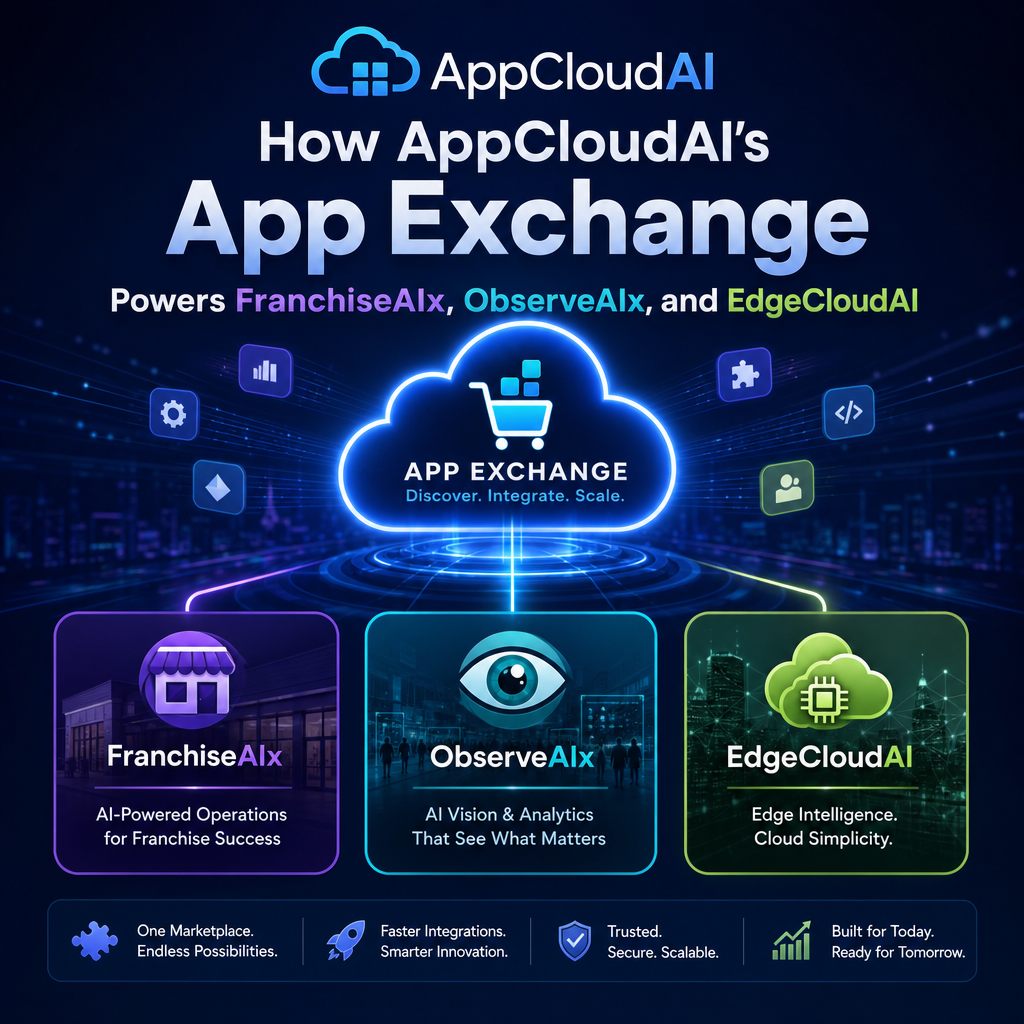
How AppCloudAI’s App Exchange Powers FranchiseAIx, ObserveAIx, and EdgeCloudAI
How AppCloudAI’s App Exchange Powers FranchiseAIx, ObserveAIx, and EdgeCloudAI
In modern enterprise software, speed matters just as much as capability. Companies want AI solutions that can be deployed quickly, adapted easily, and scaled across locations, teams, and devices without rebuilding everything from scratch.
That is where AppCloudAI’s App Exchange becomes especially valuable.

Rather than treating every AI product as a separate stack, AppCloudAI’s App Exchange acts as a shared foundation that powers specialized solutions like FranchiseAIx, ObserveAIx, and EdgeCloudAI. The result is a more flexible ecosystem where applications can be launched faster, integrated more smoothly, and improved continuously.
What Is AppCloudAI’s App Exchange?
At its core, AppCloudAI’s App Exchange is a modular platform for AI-driven apps, workflows, integrations, and reusable services.

Instead of building every feature independently for every product, teams can use a common exchange of components such as:

- AI agents and automation workflows
- Integration connectors
- Data services
- Security and access controls
- Deployment templates
- Monitoring and analytics tools
This shared approach reduces duplication and makes it easier to deliver purpose-built solutions for different industries and operational environments.
A Shared Platform, Three Distinct Solutions
One of the biggest advantages of AppCloudAI’s App Exchange is that it supports multiple products without forcing them into a one-size-fits-all model.
Each solution can be tailored to its use case while still benefiting from the same core infrastructure.
FranchiseAIx: Standardization Across Franchise Networks
Franchise businesses often struggle with consistency.
Every location needs access to the same operational playbooks, marketing tools, analytics, and customer service standards. At the same time, local operators may need some flexibility based on region, demand, or staffing.
With AppCloudAI’s App Exchange, FranchiseAIx can pull from reusable workflows and AI-enabled modules that help franchise systems stay aligned.
This can include:
- Automated knowledge delivery for franchise operators
- Consistent reporting dashboards
- Shared training and onboarding tools
- Marketing and campaign templates
- Operational support agents
Because these components live within a common exchange, updates can be deployed broadly without reinventing the experience for every location.
ObserveAIx: Smarter Monitoring and Insight
Observation and analysis tools are only as useful as the data pipelines and intelligence behind them.
ObserveAIx benefits from AppCloudAI’s App Exchange by tapping into shared connectors, analytics services, and AI models that support monitoring across systems, workflows, or customer interactions.
That means organizations can:
- Aggregate data from multiple sources
- Apply AI for anomaly detection or pattern recognition
- Create alerting workflows
- Build dashboards with reusable components
- Extend visibility without building each integration manually
The exchange model makes ObserveAIx more adaptable. As new data sources or use cases emerge, additional modules can be plugged in rather than rebuilt from the ground up.
EdgeCloudAI: AI Beyond Centralized Infrastructure
Not every AI workload belongs in a centralized cloud environment.
Some applications require lower latency, local processing, or deployment in environments with limited connectivity. That is where EdgeCloudAI stands out.
AppCloudAI’s App Exchange supports EdgeCloudAI by making it easier to package, deploy, and manage AI capabilities across distributed environments.
This is important for use cases such as:
- Retail edge operations
- Smart facilities
- Remote industrial sites
- Real-time decision systems
- On-device or near-device inference
By using standardized app components from the exchange, EdgeCloudAI can deliver local intelligence while still maintaining alignment with broader enterprise architecture.
Why the App Exchange Model Matters
The real strength of AppCloudAI’s App Exchange is not just technical reuse. It is business acceleration.
When organizations rely on a unified app ecosystem, they gain several practical advantages.
Faster Time to Value
Reusable components shorten development cycles.
Instead of waiting for custom builds, teams can assemble solutions from prebuilt modules and launch with less friction.
Better Scalability
As needs grow, new capabilities can be added through the exchange.
This helps organizations expand from one use case to many without creating disconnected systems.
Easier Governance
A centralized exchange also improves oversight.
Security rules, permissions, data standards, and compliance controls can be applied more consistently across FranchiseAIx, ObserveAIx, and EdgeCloudAI.
Continuous Improvement
When a component is upgraded inside the exchange, multiple solutions can benefit.
That creates a flywheel effect where the platform becomes more valuable over time.
From Products to Ecosystem
What makes AppCloudAI’s App Exchange especially compelling is that it turns separate products into part of a larger AI ecosystem.
FranchiseAIx focuses on operational consistency. ObserveAIx delivers intelligence and visibility. EdgeCloudAI extends AI to distributed environments.
On their own, each product solves an important challenge.
Together, they become more powerful because they are connected through a shared exchange of applications, services, and intelligence.
Final Thoughts
AI platforms are increasingly judged by how well they support real-world deployment, not just isolated features.
AppCloudAI’s App Exchange helps power FranchiseAIx, ObserveAIx, and EdgeCloudAI by providing a common foundation for modular development, integration, and scale. That foundation allows each solution to stay specialized while benefiting from shared innovation.
For organizations looking to operationalize AI across franchises, monitoring environments, and edge deployments, that kind of architecture is not just efficient. It is strategic.
