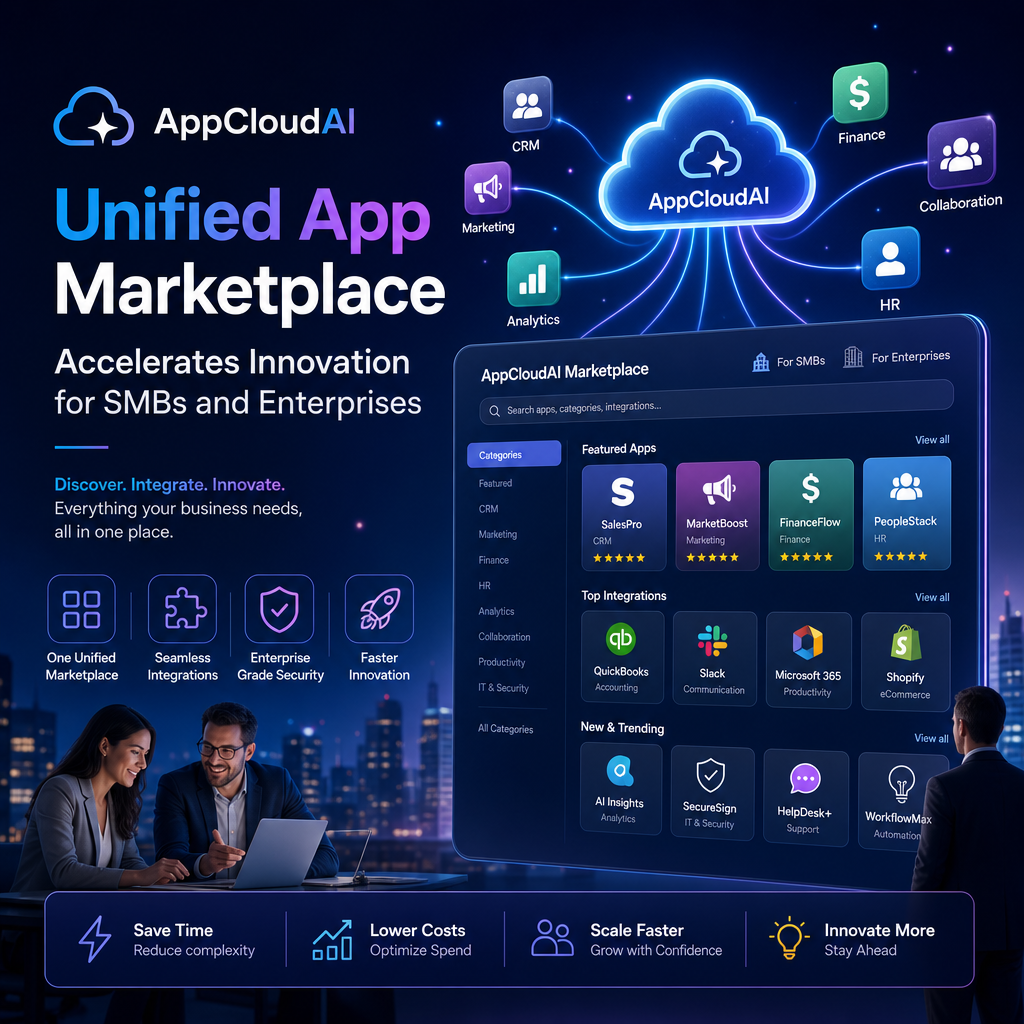
AppCloudAI Unified App Marketplace Accelerates Innovation for SMBs and Enterprises
Innovation often stalls not because businesses lack ideas, but because they lack the right tools, integrations, and speed to execute. That challenge is especially common for small and mid-sized businesses trying to scale efficiently, as well as enterprises managing complex systems across teams and regions. AppCloudAI’s Unified App Marketplace helps solve that problem by bringing applications, automation, and integration opportunities into one streamlined ecosystem.
Instead of forcing organizations to search across disconnected vendors and platforms, AppCloudAI creates a central hub where businesses can discover, deploy, and manage the solutions they need faster. The result is quicker decision-making, simpler operations, and more room for innovation.

Why a Unified App Marketplace Matters
Modern organizations rely on dozens, sometimes hundreds, of software tools. Marketing uses one platform, sales uses another, finance depends on different systems, and IT must connect everything securely.
This fragmentation creates several problems:

- Slower app discovery and procurement
- Higher integration complexity
- More duplicate tools and wasted spend
- Delayed innovation due to IT bottlenecks
- Poor visibility across the software stack
AppCloudAI’s Unified App Marketplace addresses these issues by centralizing access to business applications and services. With one marketplace experience, teams can identify the right tools faster and move from evaluation to implementation with fewer obstacles.

Faster Innovation for SMBs
For SMBs, speed and simplicity are critical. Smaller teams often do not have dedicated technical resources to evaluate every tool, manage multiple vendor relationships, or build custom integrations from scratch.
Reducing Time to Value
A unified marketplace helps SMBs adopt new solutions without lengthy procurement cycles. Instead of spending weeks researching compatibility and setup requirements, they can find pre-vetted applications that fit into their workflow more easily.
That means businesses can:
- Launch new customer experiences faster
- Automate manual processes sooner
- Experiment with new digital services at lower risk
- Scale operations without adding unnecessary complexity
Supporting Lean Teams
SMBs often need technology that works immediately and grows with them. AppCloudAI’s marketplace model supports lean teams by reducing the burden of software selection and deployment.
When teams spend less time wrestling with tool sprawl, they can spend more time on high-value work like product development, customer service, and revenue growth.
Enterprise Benefits at Scale
Enterprises face a different challenge. They usually have the budget for innovation, but scale introduces complexity. Multiple business units, compliance requirements, legacy systems, and regional needs can slow down even the most promising projects.
Creating Standardization Without Limiting Flexibility
AppCloudAI’s Unified App Marketplace gives enterprises a more organized way to manage app ecosystems. Teams can work within approved environments while still gaining access to solutions that meet their unique operational needs.
This balance is important. Enterprises need:
- Governance and security controls
- Standardized procurement processes
- Visibility into app usage and performance
- Flexibility for departments to innovate independently
A centralized marketplace supports both control and agility, helping enterprises innovate without creating unmanaged software sprawl.
Improving Cross-Team Collaboration
When app discovery and deployment happen in one shared environment, collaboration improves. IT, operations, finance, and business teams can align more easily on which tools to adopt and why.
This reduces friction between departments and creates a more consistent path from idea to execution.
Simplifying Integration and Automation
A major barrier to innovation is not just finding software, but making it work together. Even the best app loses value if it remains isolated from the rest of the business.
AppCloudAI helps reduce that friction by making integration a core part of the marketplace experience. Organizations can better connect systems, automate workflows, and build processes that move data seamlessly between departments.
What This Looks Like in Practice
A unified marketplace can support scenarios such as:
- Connecting CRM data with marketing automation
- Syncing finance and billing tools
- Automating HR onboarding processes
- Linking customer support platforms with internal knowledge systems
- Enabling analytics across previously disconnected apps
When integration becomes easier, innovation speeds up. Teams can test, deploy, and optimize new workflows without waiting for extensive custom development.
Better Governance, Better Decisions
Innovation should not come at the cost of visibility or control. One of the strongest advantages of a unified marketplace is that it gives decision-makers a clearer view of the app ecosystem.
With better oversight, businesses can:
- Eliminate redundant software
- Improve compliance and security management
- Track adoption across teams
- Make smarter investment decisions
- Identify opportunities for further automation
This is especially valuable in fast-growing organizations, where technology stacks can become chaotic quickly.
A More Strategic Approach to Growth
AppCloudAI’s Unified App Marketplace is more than a catalog of apps. It is a strategic enabler for businesses that want to move faster, operate smarter, and innovate with confidence.
For SMBs, it lowers the barriers to adopting powerful tools and competing more effectively. For enterprises, it creates structure around complexity while supporting innovation at scale.
Final Thoughts
In today’s business environment, innovation depends on access, speed, and integration. Companies that can discover and deploy the right solutions quickly are better positioned to adapt to change and capture new opportunities.
AppCloudAI’s Unified App Marketplace helps SMBs and enterprises do exactly that. By centralizing application access, simplifying integration, and improving governance, it turns technology from a source of friction into a driver of growth.
For organizations looking to accelerate innovation without increasing complexity, a unified marketplace is becoming less of a convenience and more of a competitive advantage.