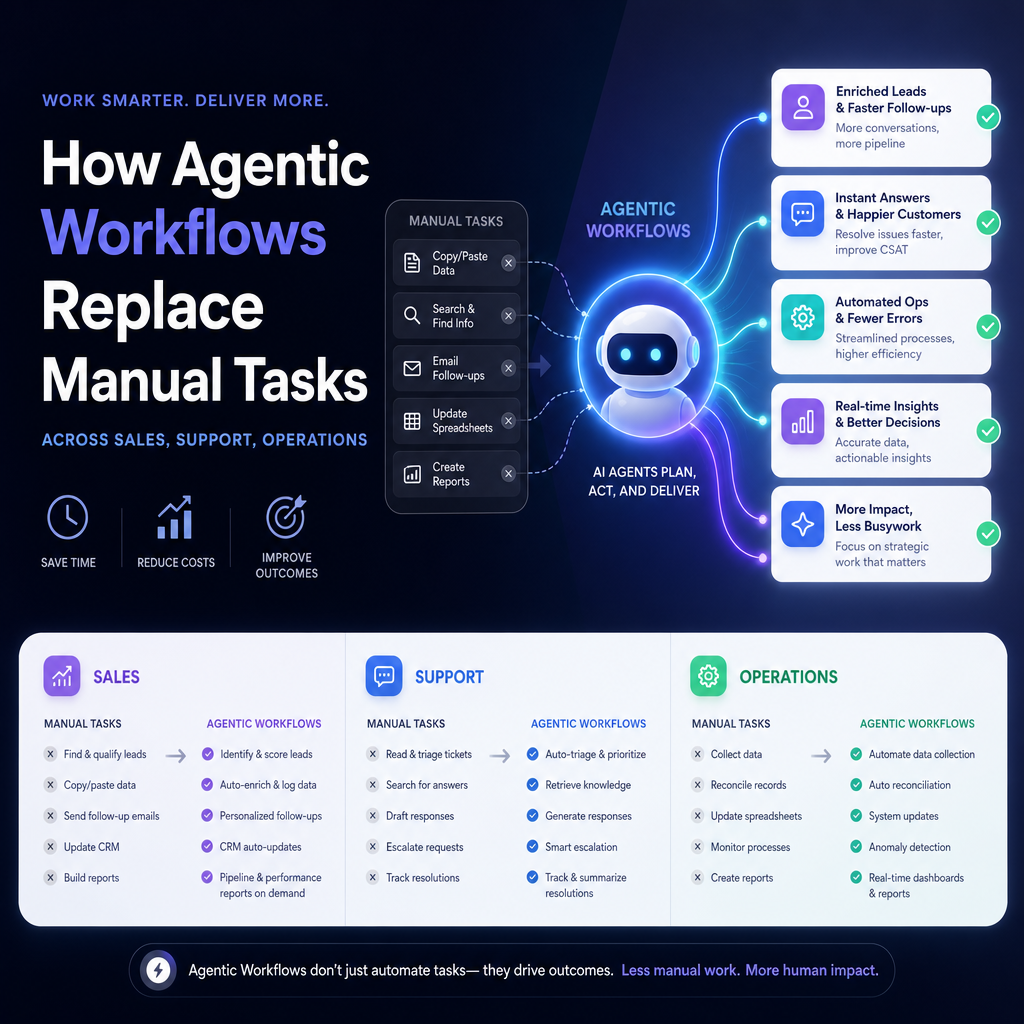
How Agentic Workflows Replace Manual Tasks Across Sales, Support, Operations
Why Agentic Workflows Matter Now
Most businesses still rely on people to move information from one system to another, chase approvals, update records, and follow up on routine tasks. These manual steps may seem small on their own, but together they slow teams down, increase errors, and make it harder to scale.
That is where agentic workflows come in.

Agentic workflows go beyond simple automation. Instead of just triggering one action after another, they can interpret context, make decisions based on rules or goals, and coordinate tasks across systems with minimal human input. In practical terms, they help teams spend less time on repetitive work and more time on customer relationships, problem-solving, and growth.
What Makes Agentic Workflows Different?
Traditional automation usually follows a fixed path:

- If a form is submitted, send an email
- If a ticket is tagged urgent, notify a manager
- If a payment clears, update a spreadsheet
These are useful, but limited.

Agentic workflows are more dynamic. They can:
- Gather information from multiple tools
- Decide the next best step
- Personalize actions based on customer history
- Escalate exceptions only when needed
- Keep processes moving without constant oversight
This shift is important because many business processes are not truly linear. Sales conversations change, support issues vary, and operational bottlenecks appear unexpectedly. Agentic systems are built to handle that variability better than rigid rule-based workflows.
How Sales Teams Replace Manual Tasks
Sales teams often lose hours every week on administrative work that does not directly generate revenue. Reps update CRM records, draft follow-up emails, qualify leads, schedule meetings, and prepare summaries after every call.
With agentic workflows, much of this can happen automatically.
Common sales tasks that can be automated
An agentic workflow can:
- Capture lead data from forms, chat, and email
- Enrich contact records using external sources
- Score and route leads to the right rep
- Draft personalized outreach based on account details
- Create meeting notes and next-step tasks after calls
- Trigger reminders when prospects go quiet
For example, instead of a rep manually reviewing every inbound lead, an agentic workflow can assess company size, buying intent, region, and product interest, then assign the lead to the correct pipeline. If the lead looks high value, it can prioritize immediate outreach. If the fit is weaker, it can place the contact into a nurture sequence automatically.
The result is faster response times, cleaner CRM data, and more selling time.
How Support Teams Reduce Repetitive Work
Customer support is full of manual triage. Agents sort tickets, copy customer details between systems, identify priority levels, and answer the same questions repeatedly.
Agentic workflows can take over much of that routine.
Support use cases for agentic workflows
Support teams can use them to:
- Classify incoming tickets by topic, sentiment, or urgency
- Surface account history before an agent responds
- Suggest or send answers to common questions
- Route issues to the correct team automatically
- Trigger refunds, password resets, or status updates
- Escalate complex cases when human judgment is needed
This does not mean replacing support agents. It means removing the repetitive work that slows them down.
A customer asking about an order delay, for instance, does not always need a human to investigate from scratch. An agentic workflow can pull shipping status, compare it against delivery SLAs, send a tailored update, and open an escalation only if the issue meets certain conditions.
That leads to shorter wait times, more consistent service, and less burnout for support teams.
How Operations Teams Gain Speed and Control
Operations is often where manual work hides in plain sight. Teams manage approvals, reconcile records, monitor exceptions, onboard vendors, and keep internal processes aligned across departments.
These tasks are ideal for agentic workflows because they involve coordination, validation, and follow-through.
Operational processes that benefit most
Examples include:
- Invoice matching and exception handling
- Employee onboarding across HR, IT, and finance
- Procurement approvals and vendor checks
- Inventory updates and reorder triggers
- Compliance documentation and audit trails
- Cross-team project handoffs
Imagine a new employee onboarding process. Instead of HR sending multiple emails and tracking responses manually, an agentic workflow can collect signed documents, create system accounts, notify managers, assign equipment requests, and verify completion across departments.
Operations leaders benefit because the workflow is not just faster. It is also more visible. Every action can be logged, measured, and improved over time.
Where Human Teams Still Matter Most
Even the best agentic workflows should not operate without boundaries.
Humans are still essential for:
- Strategic decisions
- Exception handling in sensitive cases
- Relationship management
- Policy changes and process design
- Oversight of quality, compliance, and ethics
The goal is not to remove people from the loop entirely. It is to reserve human attention for work that truly requires judgment and creativity.
Getting Started Without Overcomplicating It
The best way to adopt agentic workflows is to start with one process that is repetitive, high-volume, and easy to measure. Look for tasks that involve multiple systems, frequent handoffs, or delays caused by manual review.
A strong starting point often includes:
- Lead routing in sales
- Ticket triage in support
- Approval workflows in operations
From there, teams can refine rules, monitor outcomes, and expand into more complex use cases.
The Bigger Shift
Agentic workflows are not just another efficiency tool. They represent a new way of running business processes, where systems can act with more context, autonomy, and consistency.
Across sales, support, and operations, they replace manual tasks that drain time and create friction. Companies that adopt them thoughtfully can move faster, reduce errors, and give their teams more space to focus on valuable work.
In a business environment where speed and accuracy matter more than ever, that is a meaningful advantage.