
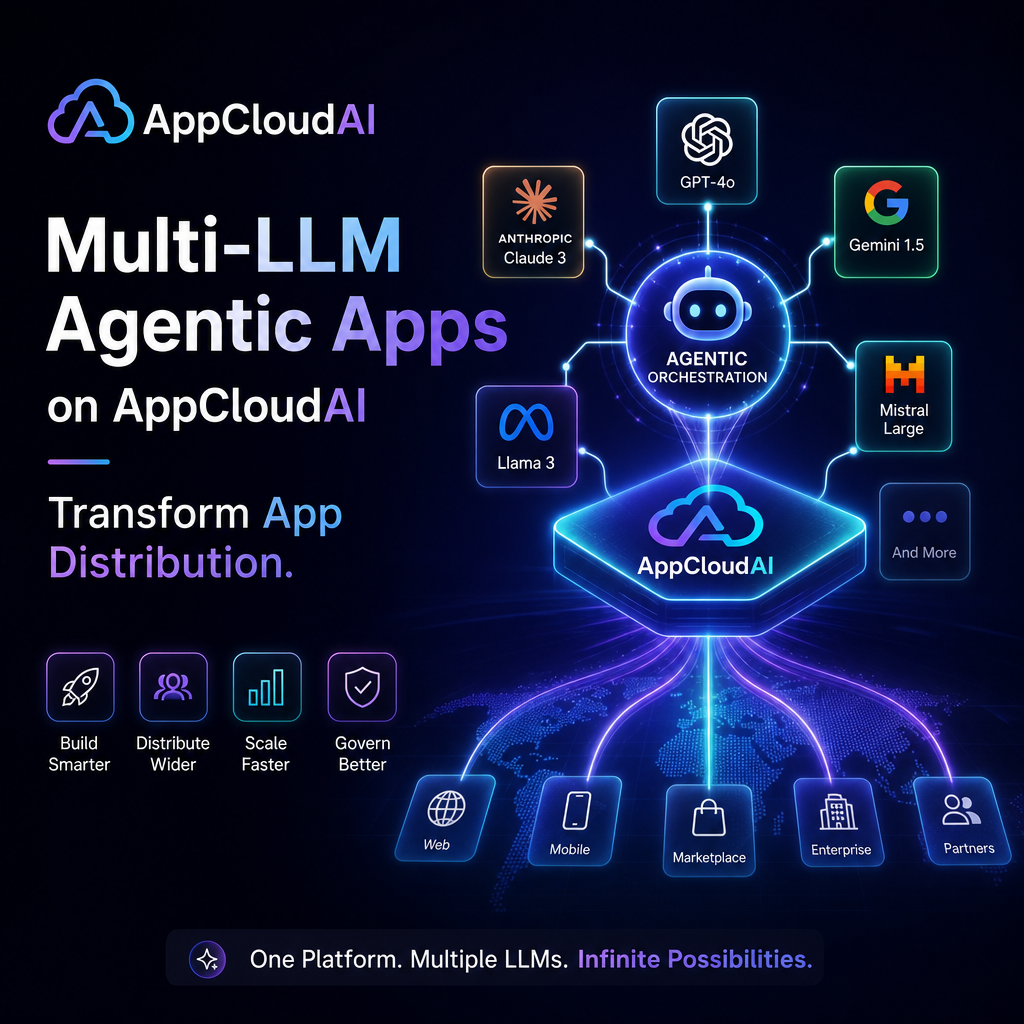
Multi-LLM Agentic Apps on AppCloudAI Transform App Distribution
The New Era of App Distribution: Multi‑LLM Agentic Apps on AppCloudAI
The app economy is changing fast. For years, distribution meant launching a mobile app, publishing it to a marketplace, and hoping users would download it. Today, that model is being challenged by something far more dynamic: multi‑LLM agentic apps.
On AppCloudAI, this shift opens the door to a new generation of software experiences—apps that do more than respond to taps and clicks. They can reason, collaborate across models, automate tasks, and adapt in real time to user goals.

What Makes This a New Era?
Traditional apps are built around fixed workflows. A user selects an option, the app follows a predefined path, and the result is delivered. That works well for simple interactions, but it becomes limiting when the task requires judgment, context, or cross-functional problem solving.
Multi‑LLM agentic apps change that model.

Instead of relying on a single large language model, these apps can orchestrate multiple models for different strengths. One model may be better at writing, another at coding, another at research, and another at structured reasoning. When combined in an agentic framework, the app becomes more capable, flexible, and useful.

On AppCloudAI, this means distribution is no longer just about delivering an interface. It is about delivering intelligence on demand.
What Are Multi‑LLM Agentic Apps?
At a basic level, a multi‑LLM agentic app is an application that uses multiple AI models and autonomous agents to complete tasks.
These apps can:
- break a complex request into smaller steps
- assign tasks to specialized models
- use tools or APIs to gather data
- evaluate intermediate outputs
- refine answers before presenting results
This is very different from a one-model chatbot.
A multi‑LLM agentic app can act more like a digital team than a single assistant. It can plan, execute, verify, and improve its own workflow.
Why Multiple LLMs Matter
No single model is perfect for every use case. Multi‑LLM design allows developers to choose the best engine for each job.
Benefits include:
- Higher quality outputs through model specialization
- Better cost control by routing lightweight tasks to cheaper models
- Improved reliability through cross-checking and fallback logic
- Greater flexibility as new models can be swapped in over time
This approach helps developers build smarter products without being locked into one AI provider.
Why AppCloudAI Is Well Positioned
AppCloudAI fits naturally into this evolution because the platform is not just about hosting apps—it is about enabling intelligent, scalable distribution for AI-native products.
For developers and businesses, that matters.
A platform designed for multi‑LLM agentic apps needs to support more than deployment. It should make it easier to manage orchestration, usage, performance, and user experience in one place. AppCloudAI creates an environment where these advanced apps can be delivered to users in a practical, accessible way.
Key Advantages of AppCloudAI
Here are a few reasons this model stands out:
1. AI-Native Distribution
Traditional app stores were built for static software. AppCloudAI is better aligned with apps that evolve, learn, and coordinate multiple AI services behind the scenes.
2. Faster Innovation Cycles
Because developers can update model routing, prompts, and agent logic without rebuilding the entire app experience, iteration becomes much faster.
3. Smarter User Experiences
Users do not need to know which model is doing what. They simply get a more accurate, context-aware result.
4. Future-Proof Architecture
As the AI landscape changes, multi‑LLM agentic apps on AppCloudAI can adapt by integrating newer models and workflows without starting from scratch.
How App Distribution Is Being Redefined
The biggest change is this: distribution is no longer just about where an app is downloaded. It is about how intelligence is delivered.
In the old model, app distribution focused on visibility, installs, and updates.
In the new model, it focuses on:
- intelligent task execution
- cloud-based orchestration
- continuous model improvement
- personalized outcomes
- service-level performance instead of static features
That is a major shift.
Users increasingly want apps that solve problems, not just provide tools. Businesses want platforms that can launch these experiences quickly and improve them continuously. Multi‑LLM agentic apps on AppCloudAI meet both needs.
Real-World Possibilities
This new distribution model can reshape many categories of software.
Examples include:
- Customer support apps that use multiple agents for triage, knowledge retrieval, and response generation
- Productivity tools that plan schedules, draft emails, summarize meetings, and automate follow-ups
- Developer platforms that combine code generation, debugging, testing, and documentation
- Research assistants that gather sources, compare insights, and synthesize findings into clear summaries
In each case, the value comes from coordination—not just generation.
What Developers Should Watch Next
As adoption grows, the most successful apps may be the ones that treat AI as an operating layer rather than a feature.
That means developers should think carefully about:
- model orchestration strategy
- agent roles and permissions
- accuracy and verification
- cost optimization
- user trust and transparency
AppCloudAI offers a promising foundation for this next phase because it aligns with how intelligent software is actually being built today.
Final Thoughts
The rise of multi‑LLM agentic apps on AppCloudAI marks a meaningful shift in how software is created and distributed. We are moving beyond static applications and into a world where apps can think in steps, collaborate across models, and deliver outcomes that feel more like services than screens.
This is not just a technical upgrade. It is a new distribution paradigm.
For developers, it creates room for better products. For businesses, it unlocks scalable AI experiences. And for users, it promises apps that are more capable, more helpful, and far more aligned with real-world needs.
That is what makes this the new era of app distribution.
