AppCloudAI vs Legacy App Stores: The Agentic Marketplace Advantage
The Agentic Marketplace Advantage: Why AppCloudAI Outperforms Legacy App Stores
The way businesses discover, deploy, and scale software is changing fast. Traditional app stores were built for a simpler era: users searched, compared ratings, installed tools, and managed everything manually. That model worked when apps were mostly standalone products.
Today, organizations need more than isolated software downloads. They need intelligent solutions that can connect workflows, automate tasks, and adapt to business goals in real time. That is where the agentic marketplace advantage becomes clear, and why AppCloudAI stands apart from legacy app stores.

What Is the Agentic Marketplace Advantage?
An agentic marketplace is not just a catalog of apps. It is a dynamic ecosystem of AI-powered agents, services, and integrations that actively help users solve problems.
Instead of asking, “Which app should I install?” users can ask, “How do I automate customer onboarding?” or “How can I reduce support response time?” The marketplace then surfaces the right agents, tools, and workflows to achieve that outcome.

This is the core of the agentic marketplace advantage:

- It is outcome-driven, not just product-driven
- It connects apps, data, and automation in one environment
- It enables intelligent recommendations instead of passive discovery
- It supports continuous optimization after deployment
Legacy app stores simply were not designed for this level of intelligence.
Where Legacy App Stores Fall Short
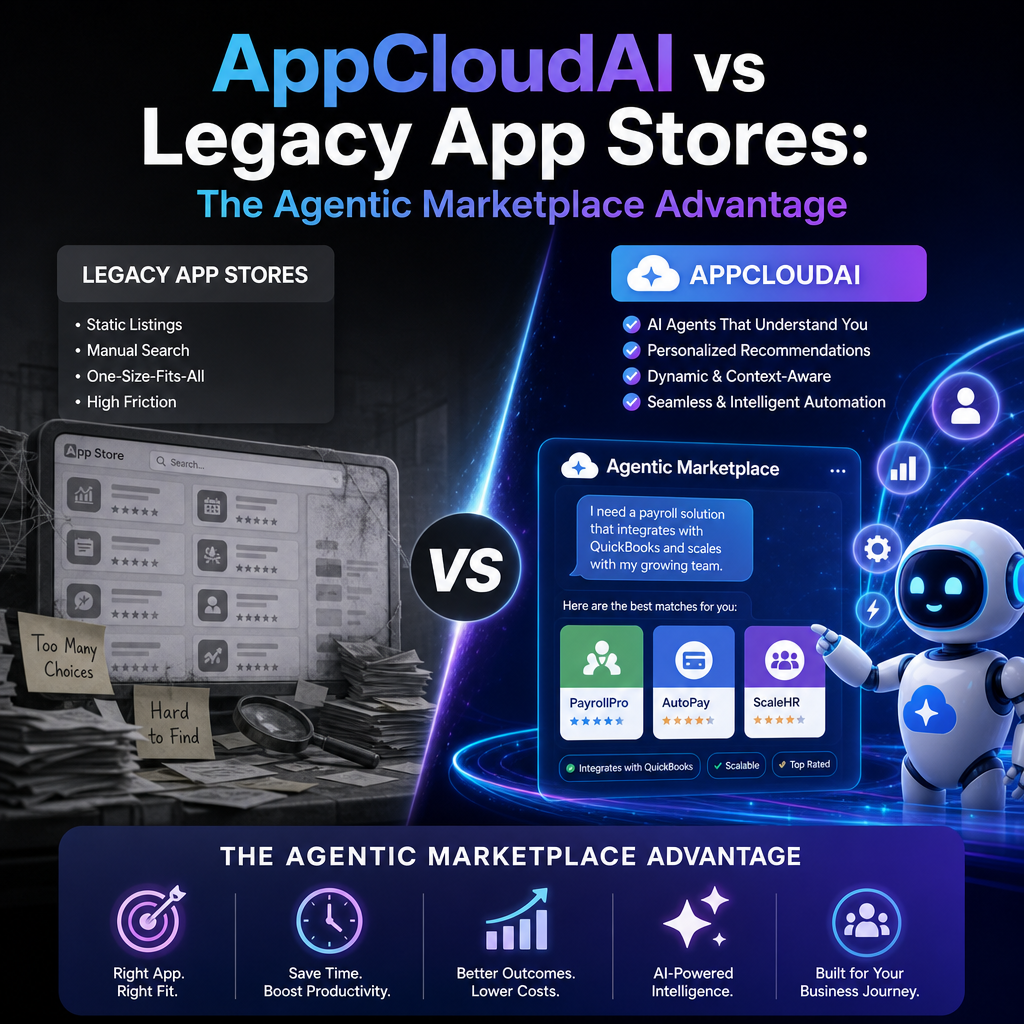
Traditional app stores have become crowded marketplaces with limited context. They are useful for browsing, but they often leave too much work to the user.
Static Discovery
Most legacy app stores rely on:
- Keyword search
- Basic category filters
- Ratings and reviews
- Manual comparison
This approach assumes users already know what they need. In reality, many businesses are trying to solve broader operational problems, not just find another piece of software.
Limited Interoperability
Even when users find the right app, implementation is often fragmented. Teams must figure out:
- Whether the app integrates with existing systems
- How to configure workflows
- How to manage permissions and data flow
- How to maintain performance across multiple tools
Legacy marketplaces rarely help beyond the point of installation.
No Ongoing Intelligence
A traditional store may help with app discovery, but it typically stops there. It does not actively monitor business needs, recommend improvements, or orchestrate multiple tools to work together more effectively.
That gap creates wasted time, tool sprawl, and lower ROI.
Why AppCloudAI Outperforms Legacy App Stores
AppCloudAI was built for a more intelligent, connected software economy. Rather than acting like a digital shelf of unrelated apps, it functions as an active marketplace where AI agents and cloud applications work together to drive business outcomes.
Intelligent, Context-Aware Recommendations
AppCloudAI goes beyond categories and reviews. It can match users with the best-fit solutions based on goals, workflows, and operational needs.
That means businesses spend less time hunting for software and more time deploying solutions that make an impact.
Built for Automation, Not Just Installation
The real value of modern software is not just in using an app. It is in what the app can automate.
AppCloudAI supports a marketplace model where intelligent agents can:
- Trigger multi-step workflows
- Connect across platforms
- Reduce manual effort
- Adapt actions based on live data
This makes the platform far more useful than a traditional store that simply delivers an app download.
Seamless Ecosystem Integration
One of the biggest strengths of AppCloudAI is its ability to unify tools inside a broader operational environment. Businesses no longer need to think in silos.
Instead of managing disconnected applications, users can build coordinated systems where agents, apps, and cloud services work together. That leads to:
- Faster deployment
- Better cross-functional collaboration
- Stronger data consistency
- More scalable automation
Continuous Optimization
AppCloudAI is not a one-time transaction platform. It is designed for ongoing performance.
As needs evolve, intelligent agents can recommend better workflows, surface complementary tools, and help organizations optimize how they use the marketplace over time. This creates a living software ecosystem rather than a static collection of apps.
The Business Value of an Agentic Marketplace
The agentic marketplace advantage is not just a technical upgrade. It translates directly into business value.
Faster Time to Value
With better recommendations and integrated deployment, teams can move from idea to implementation much faster.
Higher Productivity
AI agents reduce repetitive work and help users get more from every application in the ecosystem.
Smarter Software Decisions
Instead of choosing apps based on guesswork or popularity, businesses can make decisions based on fit, context, and measurable outcomes.
Better Long-Term ROI
When tools are connected, optimized, and actively managed, software investments deliver more value over time.
Why This Shift Matters Now
Businesses are under increasing pressure to do more with fewer resources. They need platforms that do not just offer access to software, but actively help them improve operations.
That is why the old app store model is losing relevance. Static listings and manual setup can no longer keep pace with the speed of modern business.
AppCloudAI represents the next evolution: a marketplace where intelligence, automation, and interoperability are built into the experience from the start.
Final Thoughts
The difference between AppCloudAI and legacy app stores is simple. Traditional marketplaces help users find apps. AppCloudAI helps users achieve outcomes.
That is the true agentic marketplace advantage.
By combining intelligent discovery, connected automation, and ongoing optimization, AppCloudAI delivers a modern marketplace experience built for the way businesses actually work today. For organizations seeking faster results, better software ROI, and smarter digital operations, legacy app stores are no longer enough.