The Rise of Agentic Workflows in Call and Lead Automation
Why Agentic Workflows Are Gaining Attention
Businesses have spent years trying to automate repetitive work with scripts, rule-based tools, and disconnected software. Those systems helped, but they often stopped short of true execution. They could trigger a task, send a notification, or update a record, yet people still had to step in to finish the job.
That is why agentic workflows are becoming such a major shift.

Instead of simply assisting with isolated tasks, agentic workflows combine AI reasoning, data access, and action-taking into a system that can move work forward on its own. In practice, this means an AI-powered copilot layer can handle conversations, follow up with leads, update systems, and support operations without waiting for constant human direction.
What Makes Agentic Workflows Different?
Traditional automation is usually linear. If X happens, do Y. That works well for structured tasks, but real business processes are rarely that simple.

Agentic workflows are different because they can:

- interpret intent
- use context from multiple systems
- make decisions within defined boundaries
- take the next best action
- adapt when inputs change
This makes them especially valuable in environments where speed matters and workflows cross departments.
A copilot layer acts as the interface between people, systems, and AI agents. Rather than forcing teams to jump between tools, it brings intelligence into the flow of work and helps automate entire outcomes, not just individual steps.
Automating Calls With a Copilot Layer
Phone-based workflows are a strong example of where this model shines.
Many businesses still rely on teams to answer common questions, qualify prospects, route inquiries, schedule appointments, and log notes after each interaction. These tasks are necessary, but they consume time and often create delays.
With a copilot layer in place, AI can support or automate large parts of the calling process.
What that can look like
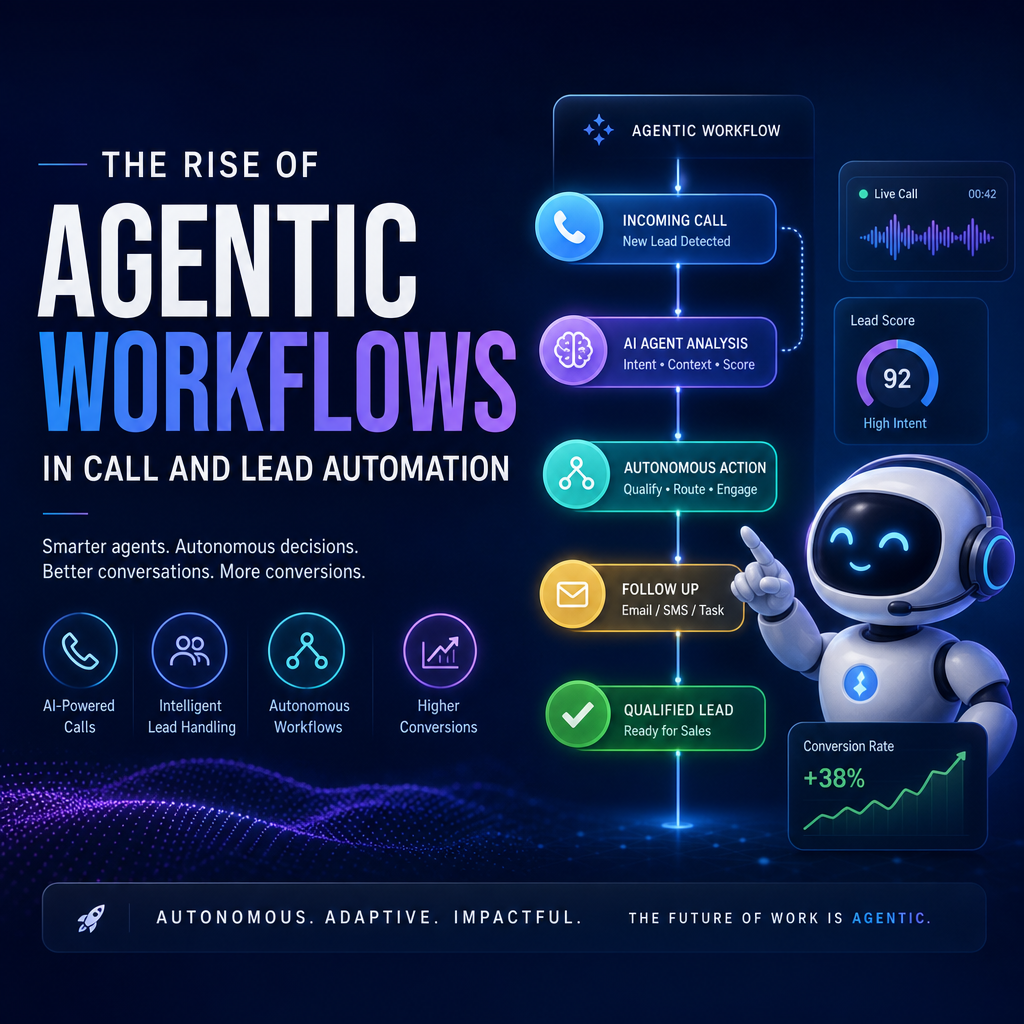
An agentic workflow for calls may:
- answer inbound calls instantly
- identify the caller’s intent
- qualify the request based on business rules
- schedule meetings or callbacks
- summarize the conversation
- update the CRM automatically
- escalate complex cases to a human agent
The result is not just faster response times. It is also better consistency. Every call can be handled with the same logic, same standards, and same follow-through, while human teams stay focused on higher-value conversations.
Transforming Lead Management End to End
Lead handling is another area where agentic workflows are changing expectations.
In many organizations, leads arrive from forms, ads, chat, referrals, and phone calls. The challenge is not collecting them. The challenge is responding fast enough, qualifying accurately, and keeping momentum after the first touch.
A copilot layer helps close that gap.
How agentic workflows improve lead operations
Once a lead enters the system, AI can:
- enrich the lead with available data
- score it based on fit and intent
- trigger personalized outreach
- book meetings automatically
- route high-priority leads to sales
- nurture lower-intent leads over time
- log every action in the CRM
This creates a smoother handoff between marketing and sales. It also reduces the risk of leads being missed because someone forgot to follow up or update a pipeline stage.
For businesses competing on speed-to-lead, that matters. The faster and more intelligently a lead is handled, the greater the chance of conversion.
Operational Workflows Are the Next Frontier
The real power of agentic workflows goes beyond customer-facing tasks. Operations teams are also beginning to benefit from a copilot layer that connects fragmented systems and drives execution.
Operational bottlenecks often come from repetitive coordination work:
- checking status across tools
- sending reminders
- updating records
- creating tickets
- escalating issues
- compiling reports
These tasks may seem small on their own, but together they create drag across the organization.
With agentic workflows, AI can monitor signals, detect issues, and take action automatically. For example, it can identify a missed appointment, notify the right team, trigger a follow-up call, and update the relevant dashboard in one continuous flow.
That kind of orchestration turns operations from reactive to proactive.
Why the Copilot Layer Matters
The phrase “copilot layer” is important because it describes more than a chatbot or assistant. It is the intelligence layer that sits on top of business tools and connects them into a coordinated system.
A strong copilot layer should be able to:
Connect Across Systems
It needs access to CRM platforms, communication tools, scheduling software, knowledge bases, and operational systems.
Understand Context
It should know who the customer is, what stage the lead is in, what actions have already happened, and what business rules apply.
Take Action Safely
It must operate within guardrails, with clear permissions, escalation paths, and auditability.
Improve Over Time
As it sees more interactions and outcomes, it should help teams refine workflows and identify where automation delivers the most value.
The Business Impact of Agentic Workflows
The rise of agentic workflows is not just a technology story. It is an operating model shift.
Companies adopting this approach can often expect:
- faster response times
- improved lead conversion
- lower manual workload
- more consistent customer interactions
- better visibility across operations
- greater scalability without linear headcount growth
This is especially important for teams under pressure to do more with less. When AI can handle routine execution across calls, leads, and back-office tasks, people are free to focus on strategy, relationships, and exception handling.
Final Thoughts
Agentic workflows are moving automation beyond simple task triggers and into real business execution. By introducing a copilot layer that can understand context, make decisions, and take action, organizations can automate calls, streamline lead management, and improve daily operations at scale.
The businesses that benefit most will not be the ones that treat AI as a side tool. They will be the ones that build it into the core flow of work.
That is where agentic workflows are headed, and why they are quickly becoming a competitive advantage.