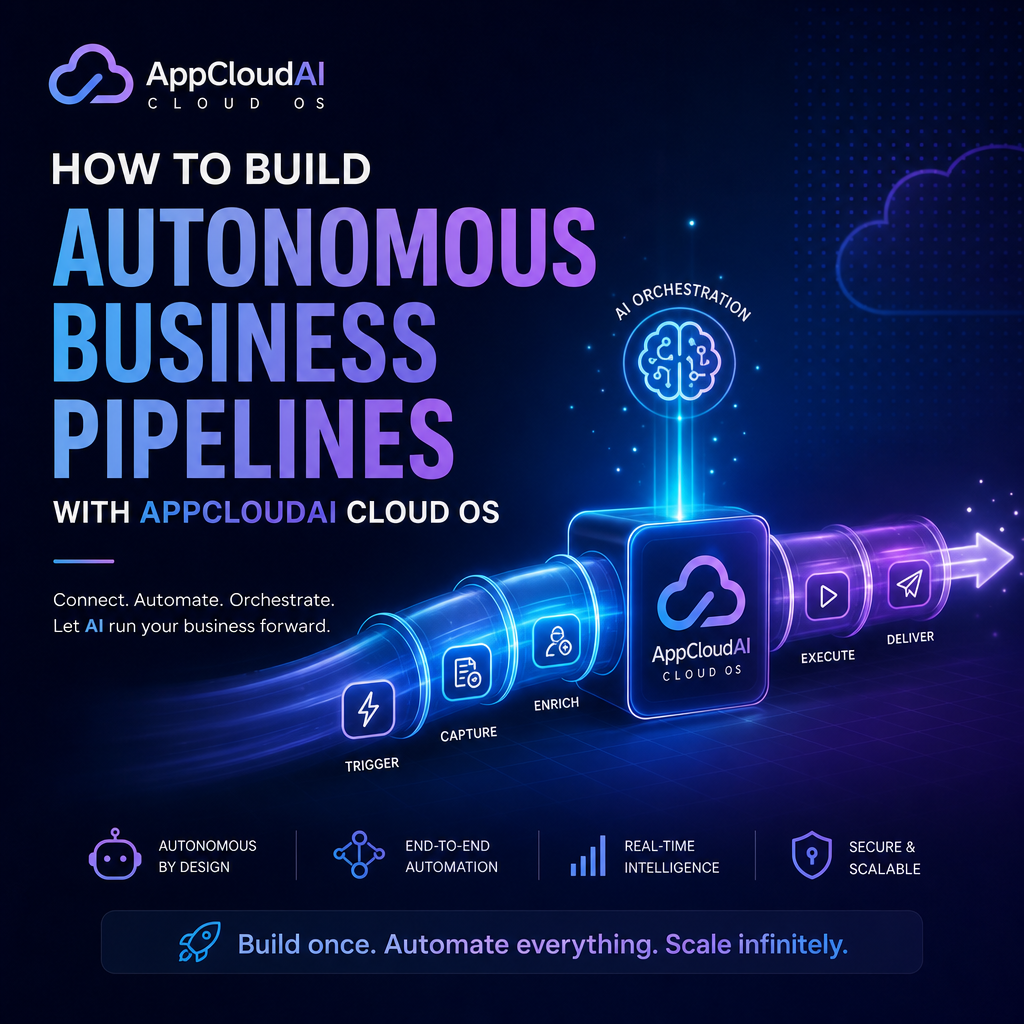
How to Build Autonomous Business Pipelines With AppCloudAI Cloud OS
Building Autonomous Business Pipelines With AppCloudAI’s Multi-Agent Cloud OS
Modern businesses run on workflows: capturing leads, qualifying opportunities, routing support tickets, processing documents, generating reports, and following up with customers. The problem is that many of these workflows still rely on disconnected tools, manual handoffs, and repetitive effort.
That’s where AppCloudAI’s Multi-Agent Cloud OS changes the equation.

Instead of treating automation as a set of isolated scripts or one-off integrations, a Multi-Agent Cloud OS creates a coordinated system of intelligent agents that can work together across the business. The result is a more autonomous pipeline—one that doesn’t just move data, but can interpret tasks, make decisions, and adapt in real time.
What Is a Multi-Agent Cloud OS?
At its core, AppCloudAI’s Multi-Agent Cloud OS is a cloud-based environment where specialized AI agents collaborate to complete business processes from end to end.

Rather than relying on a single general-purpose bot, this model uses multiple agents with defined roles. For example, one agent may monitor inbound requests, another may validate data, another may trigger actions in SaaS apps, and another may generate summaries or insights for human review.

This approach brings structure to AI-driven automation.
Why the multi-agent model matters
A multi-agent architecture is useful because business operations are rarely linear. Most pipelines involve:
- Multiple systems
- Different decision points
- Approval loops
- Exceptions and edge cases
- Human collaboration
A single automation rule often breaks when the process becomes too dynamic. By contrast, AppCloudAI’s Multi-Agent Cloud OS allows agents to divide responsibilities and coordinate actions based on context.
From Basic Automation to Autonomous Pipelines
Traditional automation is good at simple, predefined tasks:
- “If a form is submitted, send an email.”
- “If a payment clears, update the CRM.”
- “If a ticket is tagged urgent, alert support.”
These rules save time, but they don’t truly operate autonomously. They depend on fixed logic and can struggle when inputs change or when decisions need interpretation.
Autonomous business pipelines go further.
With AppCloudAI’s Multi-Agent Cloud OS, agents can:
- Understand unstructured inputs like emails, documents, and chat messages
- Decide which workflow path to follow
- Pull information from multiple sources
- Execute actions across connected platforms
- Escalate only when human intervention is actually needed
This creates a pipeline that is not just automated, but intelligently orchestrated.
Practical Business Use Cases
The value of AppCloudAI’s Multi-Agent Cloud OS becomes clear when you look at real operational scenarios.
Sales and lead management
Incoming leads often arrive from websites, ads, forms, email, and partner channels. A multi-agent pipeline can:
- Capture and normalize lead data
- Enrich profiles with external information
- Score and prioritize opportunities
- Route qualified leads to the right rep
- Trigger personalized follow-up sequences
Instead of relying on manual triage, the pipeline keeps momentum from first contact to handoff.
Customer support operations
Support teams deal with high volumes, inconsistent inputs, and urgency-based routing. With AppCloudAI’s Multi-Agent Cloud OS, agents can classify issues, detect sentiment, retrieve account data, recommend solutions, and assign tickets appropriately.
This reduces response delays and helps support teams focus on complex cases.
Finance and document workflows
Invoice handling, vendor onboarding, contract review, and compliance checks often involve repetitive administrative work. A multi-agent pipeline can extract key fields, validate data, flag anomalies, request approvals, and update downstream systems automatically.
That means faster turnaround and fewer errors.
Key Benefits for Growing Teams
For companies looking to scale without constantly adding operational overhead, AppCloudAI’s Multi-Agent Cloud OS offers several clear advantages.
1. Faster execution
Agents can operate continuously, reducing wait times between steps and keeping workflows moving around the clock.
2. Better consistency
Standardized agent behavior helps reduce the variability that often comes with manual processing.
3. Smarter exception handling
Not every process fits a perfect template. Multi-agent systems can interpret context and adapt instead of simply failing when a workflow changes.
4. Improved human productivity
Teams spend less time on repetitive coordination and more time on judgment, strategy, and customer relationships.
5. Easier scaling
As business complexity increases, new agents can be added for specific functions without rebuilding entire systems from scratch.
What to Consider Before Implementation
Autonomous pipelines are powerful, but success depends on thoughtful design.
Before rolling out AppCloudAI’s Multi-Agent Cloud OS, organizations should identify:
- Which workflows are high-volume and rules-heavy
- Where delays or bottlenecks happen most often
- Which decisions can be safely delegated to AI agents
- What guardrails, approvals, and audit trails are required
- How humans will stay informed and in control
The goal is not to remove people from the process entirely. It is to let people focus where they add the most value.
The Future of Business Operations
As companies face growing pressure to move faster, operate leaner, and serve customers better, static automation will no longer be enough. Businesses need systems that can coordinate work across tools, teams, and decision points with minimal friction.
That is the promise of AppCloudAI’s Multi-Agent Cloud OS.
By enabling intelligent agents to collaborate inside autonomous business pipelines, organizations can turn fragmented workflows into responsive, scalable operating systems. The shift is significant: from managing tasks one step at a time to building pipelines that can think, act, and improve as the business grows.
For teams ready to move beyond basic automation, this is not just a technical upgrade. It’s a new model for how work gets done.