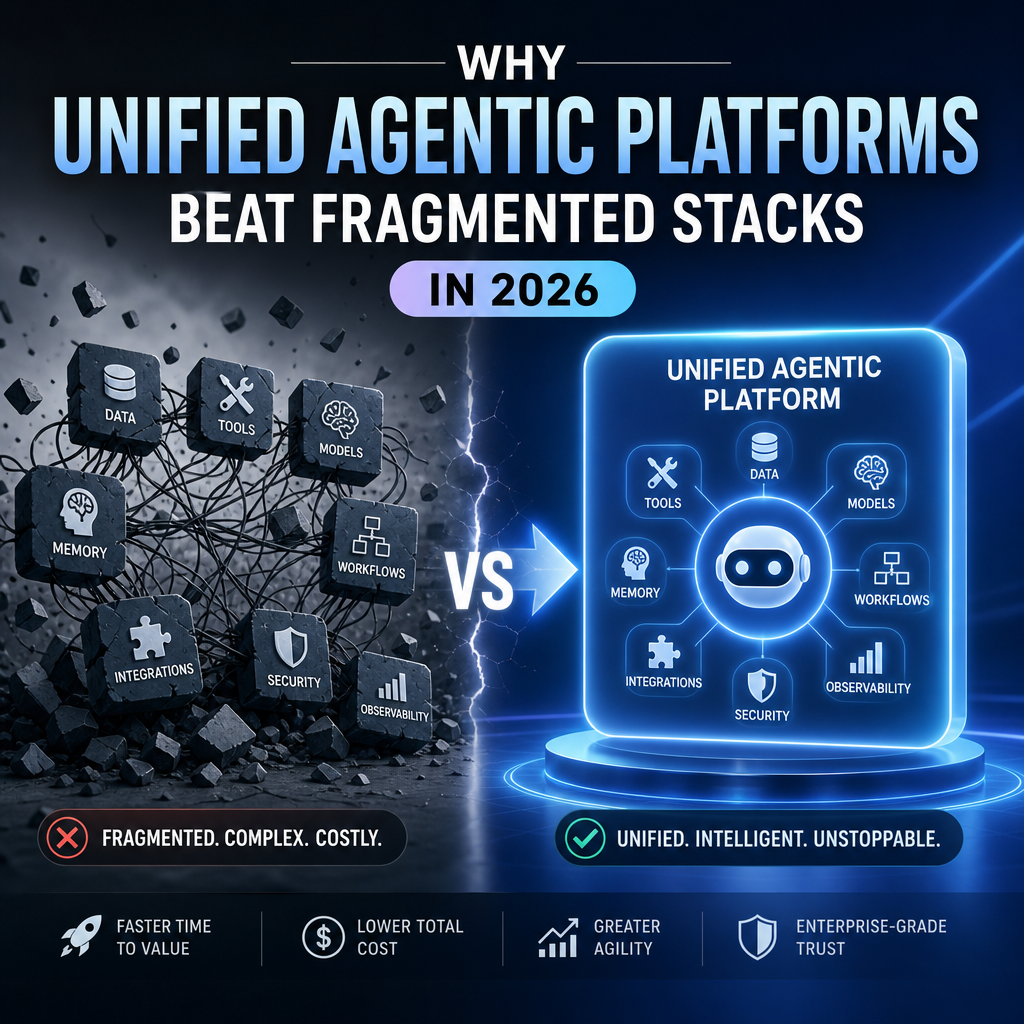
Why Unified Agentic Platforms Beat Fragmented Stacks in 2026
Why Unified Agentic Platforms Outperform Fragmented Stacks in 2026
In 2026, the AI conversation is no longer about whether companies should use agents. It is about how they should deploy them at scale without creating chaos. That is where unified agentic platforms have taken the lead over fragmented stacks.
Many organizations started by stitching together models, workflow tools, vector databases, observability layers, security controls, and custom integrations. That approach worked for experiments. It does not work nearly as well for production environments where speed, governance, and reliability matter.

As AI agents move from pilots to core business operations, unified platforms are proving to be the smarter long-term choice.
The Problem With Fragmented AI Stacks
A fragmented stack usually grows in layers. One team picks a model provider. Another adds orchestration. Security gets bolted on later. Then analytics, identity, memory, and monitoring are added through separate vendors.

At first, this feels flexible. In practice, it creates friction.

Common problems include:
- Too many handoffs between tools
- Inconsistent access controls and security policies
- Poor visibility into agent behavior across systems
- Slow deployment cycles due to integration work
- Rising operational costs from overlapping vendors
- Difficulty troubleshooting failures across multiple layers
When every capability lives in a different product, teams spend more time managing the stack than improving outcomes.
What Makes Unified Agentic Platforms Different?
Unified agentic platforms bring the full agent lifecycle into one environment. That usually includes:
- Model access and routing
- Agent orchestration
- Memory and retrieval
- Tool and API connectivity
- Identity and permissions
- Observability and evaluation
- Governance and policy enforcement
Instead of forcing teams to connect separate products, the platform is designed to make these parts work together from the start.
This matters because agentic systems are not static applications. They plan, act, call tools, reason across data, and adapt to context. Managing that behavior across a fragmented stack introduces more failure points. A unified platform reduces those points and makes the whole system easier to trust.
Speed Becomes a Competitive Advantage
In 2026, companies are under pressure to move quickly from prototype to production. Unified agentic platforms make that possible.
With fewer integrations to build and maintain, teams can:
- Launch agents faster
- Test workflows more easily
- Reuse components across departments
- Roll out updates without breaking dependencies
Speed is not just about developer convenience. It directly affects business results. A company that can deploy customer support agents, internal research agents, and process automation agents in weeks instead of months gains a meaningful edge.
Fragmented stacks often delay that progress because every new use case requires more custom work.
Better Governance in a More Regulated Environment
AI governance has become a board-level concern. By 2026, organizations are facing stricter expectations around compliance, auditability, data handling, and model accountability.
Unified agentic platforms outperform here because governance is built into the operating layer rather than patched in later.
Why governance works better in one platform
A unified approach allows companies to:
- Apply consistent policies across all agents
- Track decisions, actions, and tool usage centrally
- Enforce role-based access across teams
- Monitor sensitive data movement in one place
- Audit agent behavior without chasing logs across vendors
In a fragmented environment, visibility is often incomplete. That makes compliance harder and increases risk.
Lower Total Cost Over Time
A fragmented stack can appear cheaper at the start because teams choose point solutions based on immediate needs. But over time, hidden costs build up.
These costs often include:
- Integration engineering
- Vendor management overhead
- Duplicate capabilities
- More incidents and slower resolution
- Retraining teams on multiple systems
- Higher security and compliance effort
Unified agentic platforms reduce this complexity. Even if the upfront platform investment looks larger, the total cost of ownership is often lower because operations become more efficient.
This is especially true for enterprises running many agents across departments. At scale, simplicity becomes an economic advantage.
Performance Improves When Systems Work Together
AI agents perform best when context, memory, tools, and governance are tightly connected. Unified platforms are designed around that principle.
For example, an agent handling procurement tasks may need to:
- Access company policy
- Retrieve vendor history
- Call finance APIs
- Ask for approval based on budget thresholds
- Log every step for review
In a fragmented stack, each of those steps may depend on different tools with different failure modes. In a unified environment, the workflow is more coherent, easier to optimize, and easier to observe.
That translates into:
- Higher reliability
- Better response quality
- Fewer workflow breakdowns
- Stronger user trust
The 2026 Reality: Enterprises Want Platforms, Not Puzzles
The market has matured. Companies are no longer impressed by stacks that require constant tuning just to stay functional. They want systems that help them scale AI safely and efficiently.
That is why unified agentic platforms are winning in 2026. They align technical performance with business needs:
- Faster deployment
- Stronger governance
- Lower operational burden
- Better scalability
- More dependable agent behavior
Fragmented stacks still have a place in highly specialized experiments. But for organizations building real, durable AI operations, they increasingly look like a temporary phase rather than the final answer.
Final Thoughts
The shift toward unified agentic platforms reflects a larger lesson in enterprise AI: integration is not strategy. Execution is.
As agents become embedded in workflows across support, operations, finance, and knowledge work, the organizations that succeed will be the ones using platforms built for coordination, control, and scale.
In 2026, unified agentic platforms do not just simplify the stack. They make agent-driven business possible.