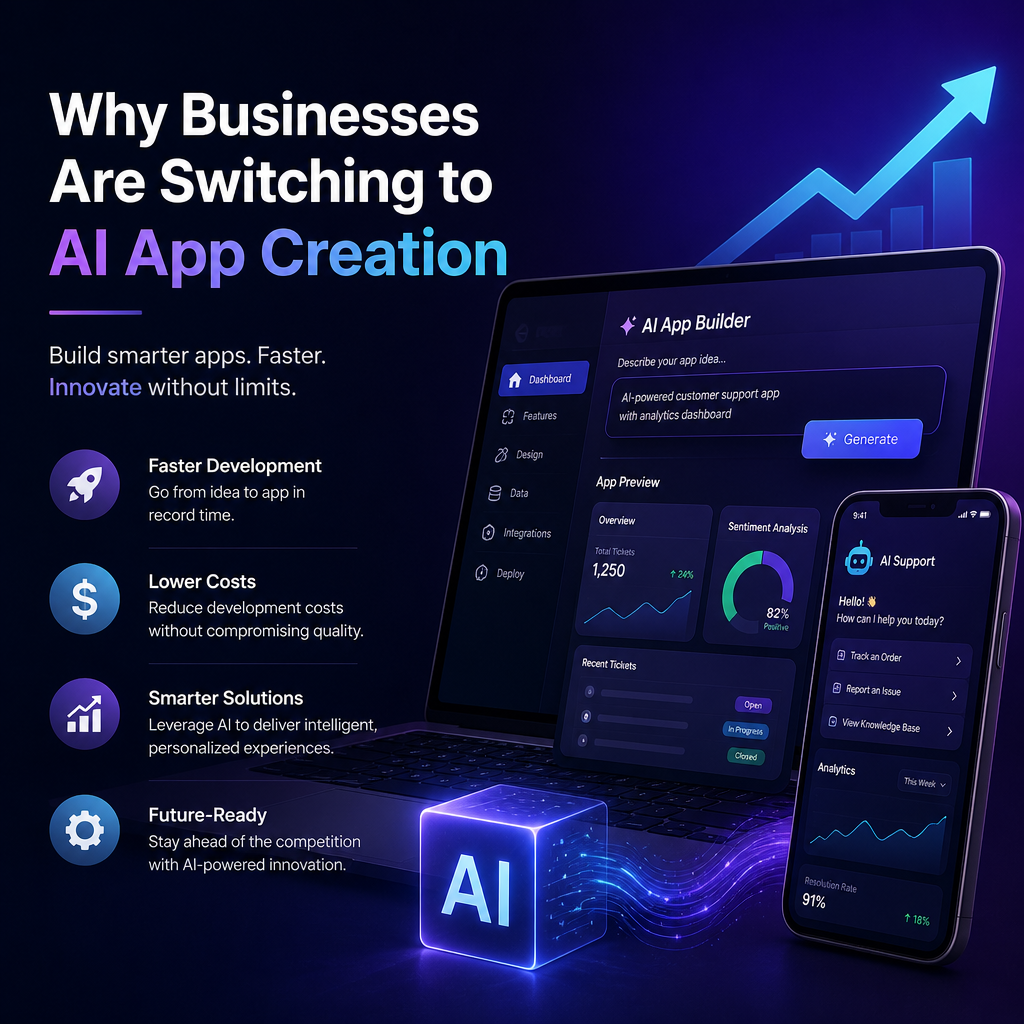
Why Businesses Are Switching to AI App Creation
Why Businesses Are Switching from Traditional Development to AI App Creation
Businesses have long relied on traditional software development to build apps, automate workflows, and serve customers. That approach remains valuable, especially for complex or highly customized systems. But as organizations face pressure to move faster and do more with limited resources, many are turning to AI app creation.
AI-powered tools can help teams design, build, and improve applications with less manual effort. The result is not simply faster coding. It is a different way to turn business needs into working software—one that can make development more accessible, adaptable, and responsive.

What AI App Creation Changes
Traditional development often requires a dedicated team to move through planning, design, coding, testing, and deployment. Even a relatively small app can take weeks or months, particularly when requirements change along the way.
AI app creation tools can assist across several stages. Depending on the platform, users may describe an app in everyday language, generate interface elements, create or refine code, and connect data sources through visual workflows. Developers can then review, customize, and test the output.

This does not eliminate software expertise. Instead, it can reduce repetitive work and help people focus on decisions that require human judgment.

Why Businesses Are Making the Switch
Faster Development Cycles
Speed is one of the most visible advantages. AI can help create prototypes, draft code, and suggest fixes quickly, allowing teams to test ideas sooner. Rather than waiting for a full development cycle, a business can build an initial version, gather feedback, and refine it in stages.
A faster start can be especially helpful for internal tools, customer portals, and proof-of-concept projects. Teams can evaluate whether an idea is useful before committing significant time and budget.
Greater Access to App Building
Not every useful business application requires a large engineering team. Marketing, operations, and customer service teams often understand their own processes well, but may have limited access to developers.
AI-assisted and no-code platforms can help these employees create simple applications or automate tasks with less reliance on specialized coding skills. Developers still play an important role, particularly when apps need custom logic, integrations, or stronger security. But more people can contribute to the process.
Lower Costs for Certain Projects
Traditional development costs can rise when projects involve long timelines, multiple rounds of revision, or scarce technical talent. AI tools may reduce some of that effort by automating routine tasks and accelerating early-stage development.
The savings are not automatic. Businesses still need to account for platform fees, implementation, testing, governance, and ongoing maintenance. However, for straightforward applications, AI-assisted workflows can make experimentation and delivery more affordable.
Easier Iteration
Business needs change, and software must often change with them. AI tools can help teams adjust interfaces, revise features, or generate alternative approaches without restarting from scratch.
That flexibility supports a more iterative way of working. Teams can release a useful first version, observe how people use it, and prioritize improvements based on real feedback rather than assumptions.
The Role of Developers Is Evolving
AI app creation is changing how developers spend their time, not making them unnecessary. Developers can use AI to handle boilerplate code, explore solutions, and speed up debugging. They can then focus more attention on architecture, performance, security, accessibility, and complex integrations.
Human review remains essential. AI-generated code may contain errors, introduce vulnerabilities, or misunderstand a business requirement. Skilled professionals are needed to verify that an application works correctly and can be maintained over time.
Important Considerations Before Adopting AI Tools
Businesses should choose AI development tools carefully and set clear rules for their use. Before building an application, consider:
- Data privacy: Understand how the platform stores and processes company or customer data.
- Security: Review generated code, access controls, and integration risks.
- Quality assurance: Test apps thoroughly before relying on them in critical workflows.
- Ownership and portability: Check whether the business can export its code and data if it changes platforms.
- Governance: Establish who can build, approve, and maintain applications.
These precautions help organizations benefit from faster creation without overlooking long-term responsibilities.
A More Flexible Path to Software
The move from traditional development to AI app creation is not an all-or-nothing choice. Many businesses will combine approaches: using AI to accelerate prototypes and routine applications while relying on experienced developers for mission-critical systems.
As the tools improve, companies that learn to use them thoughtfully may respond more quickly to customer needs and internal challenges. The biggest advantage is not that AI builds every app on its own. It is that more teams can turn good ideas into practical software—and improve that software with less friction.