
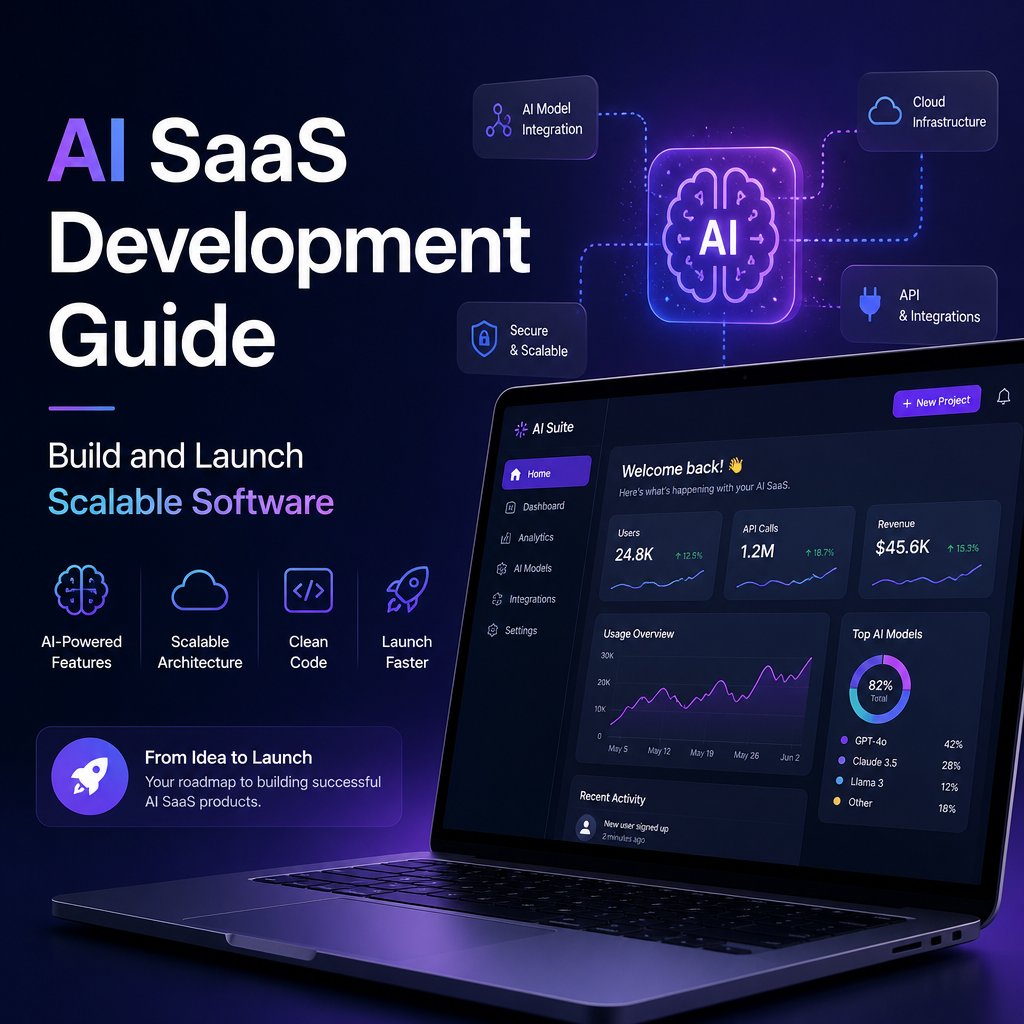
AI SaaS Development Guide: Build and Launch Scalable Software
AI SaaS Development Guide: From Idea to Scalable Product
Building an artificial intelligence product as a software-as-a-service platform requires more than connecting an app to a large language model. A successful product solves a specific customer problem, delivers reliable results, protects data, and operates at a sustainable cost.
This AI SaaS Development Guide walks through the key decisions involved, from validating an idea to launching and improving the product.

1. Start With a Specific Problem
The strongest AI products address a clear, recurring task. “Use AI to improve productivity” is too broad to guide product development. A more useful goal might be helping customer support teams summarize conversations or enabling finance departments to categorize invoices.
Before choosing a model or building a prototype, answer three questions:

- Who will use the product?
- What task will it make faster, easier, or more accurate?
- How do customers handle that task today?
Interview potential users and observe their current workflows. Look for repetitive work, costly delays, and processes that depend on searching through large amounts of information. These details help you identify where AI can create measurable value.

2. Define the Product’s AI Role
AI is not automatically the right solution for every feature. Some workflows are better handled with conventional software, rules, or simple automation. Use AI where it offers a meaningful advantage, such as interpreting natural language, recognizing patterns, or producing useful summaries.
Decide what the system should do and where people should remain in control. For example, an AI tool might draft a response while requiring a human to approve it before sending. This approach can reduce risk and build user trust, especially in high-impact workflows.
Also set clear expectations. Generative AI can produce incorrect or inconsistent results. Communicate limitations, give users ways to review outputs, and avoid presenting uncertain answers as facts.
3. Choose an Architecture That Fits
Most AI SaaS products combine a user-facing application, backend services, data storage, and one or more AI components. The right design depends on the product’s needs, expected traffic, privacy requirements, and budget.
A typical architecture may include:
- Frontend: The web interface where users submit requests and review results.
- Backend: Authentication, business logic, billing, and coordination of AI tasks.
- Model layer: An external model API, a hosted open-source model, or a model deployed on your own infrastructure.
- Data layer: A database for accounts, settings, product records, and relevant content.
- Monitoring: Tools to track errors, latency, usage, and model performance.
For an early product, an external model API can help you validate demand quickly without managing specialized infrastructure. As usage grows, compare providers and deployment options based on quality, response time, data handling, and total cost—not just model pricing.
4. Prepare Data and Improve Outputs
Good results depend on more than the model itself. If the product answers questions about a company’s documents, for example, it needs reliable access to the right information.
Retrieval-augmented generation (RAG) is one common approach. It searches a collection of approved content, supplies relevant passages to a language model, and uses those passages to help generate an answer. RAG can make responses more relevant without retraining a model, but it requires thoughtful document processing, search, and permissions.
Test the system with realistic examples before launch. Create an evaluation set that reflects common requests, unusual cases, and likely failure points. Review outputs for accuracy, relevance, clarity, and consistency. Track changes as you adjust prompts, models, or data sources.
5. Build for Security and Privacy
AI SaaS platforms may process sensitive information, so security should be part of the design from the beginning. Use encryption, access controls, secure authentication, and clear data-retention policies. Separate customer data appropriately, and verify that users can access only the information they are authorized to see.
Review the terms and privacy practices of any model provider. Understand whether submitted data may be retained or used for training, and explain your own practices clearly to customers. Depending on your industry and market, you may also need to meet specific regulatory or contractual requirements.
6. Manage Cost and Reliability
Model usage can become a major operating expense. Estimate cost per user or task early, then monitor actual usage after launch. Set appropriate rate limits and consider caching repeated results, shortening unnecessary prompts, or routing simpler tasks to lower-cost models.
Reliability matters just as much. Plan for provider outages, slow responses, and unexpected model errors. Useful safeguards include timeouts, retries with limits, fallback options, and clear messages when a request cannot be completed.
7. Launch, Measure, and Improve
Start with a focused version of the product rather than trying to automate an entire business process. Invite a small group of target users, watch how they use it, and collect feedback on both the experience and the quality of AI-generated results.
Measure outcomes that reflect customer value, such as time saved, tasks completed, or fewer manual corrections. Usage alone does not prove that a product is useful. Combine analytics with interviews and support requests to understand what is working and what needs attention.
The best AI SaaS products evolve through careful testing. Begin with a real problem, make the AI’s role clear, protect customer data, and improve the system using evidence from actual use. That disciplined approach turns a promising prototype into a product people can rely on.


