
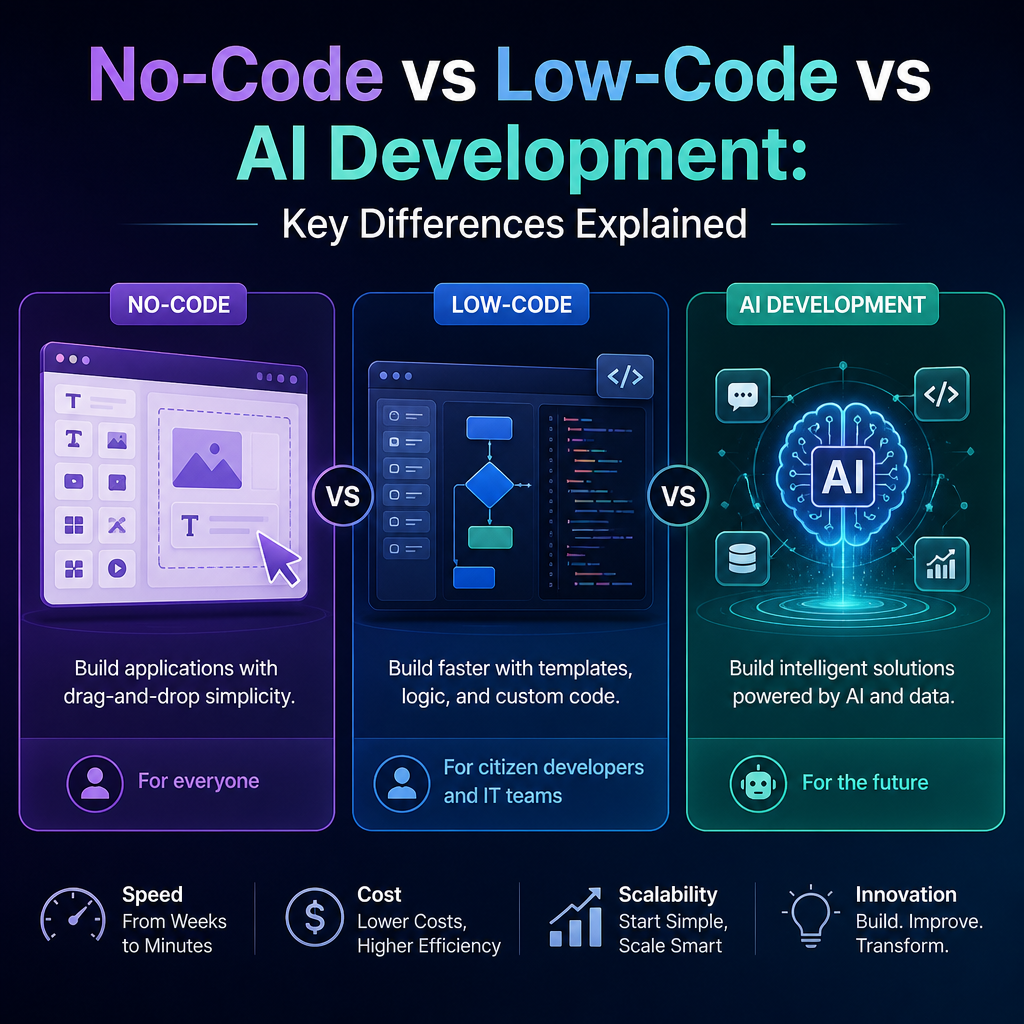
No-Code vs Low-Code vs AI Development: Key Differences Explained
No-Code vs. Low-Code vs. AI Development: What’s the Difference?
Building software no longer always means writing every line of code by hand. No-code platforms, low-code tools, and AI development can all help teams create applications faster, but they work in different ways and suit different needs.
Understanding the differences can help businesses choose an approach that fits their goals, skills, budget, and technical requirements.

What Is No-Code Development?
No-code development lets people build applications without writing code. Instead, users work with visual tools such as drag-and-drop editors, templates, forms, and workflow builders.
A no-code platform might let a small business create a website, automate a routine task, or build an internal app by connecting prebuilt components. The platform handles the underlying code.

Benefits of no-code
- Accessible to non-technical users: Teams can create simple tools without relying on developers.
- Fast to launch: Templates and visual editors can shorten development time.
- Useful for prototypes: Businesses can test an idea before investing in a custom build.
No-code is often a good fit for straightforward projects, such as event registration, basic customer portals, or simple approval workflows. Its limitations tend to appear when an application needs extensive customization, complex integrations, or performance at a large scale.

What Is Low-Code Development?
Low-code development also uses visual tools and prebuilt components, but it allows developers to add custom code when needed. This combination makes low-code platforms more flexible than no-code tools while still accelerating common development tasks.
A developer might use a low-code platform to assemble an application’s screens and workflows, then write code for a specialized feature or integration.
Benefits of low-code
- More customization: Developers can extend the platform with code.
- Faster delivery: Reusable components reduce repetitive work.
- Better support for complex systems: Low-code tools can connect with databases, APIs, and existing business software.
Low-code is often suited to internal business applications, customer-facing services, and workflows that require both speed and tailored functionality. It still requires technical oversight, especially for security, architecture, and long-term maintenance.
What Is AI Development?
AI development uses artificial intelligence to assist with creating, testing, or operating software. In this context, it can mean using AI tools to generate code, explain errors, suggest tests, or help design application components. It can also mean building software that includes AI features, such as chatbots, recommendations, or document analysis.
These are related but distinct uses. A team might use an AI coding assistant to build a conventional application, or it might develop an application whose core feature relies on an AI model.
Benefits and considerations
AI tools can help developers move faster by producing code suggestions, drafting documentation, and automating routine tasks. They can also make software interactions more flexible, such as allowing users to search documents with natural-language questions.
However, AI-generated output needs review. It may contain errors, expose sensitive information if used carelessly, or fail to meet security and compliance requirements. AI features can also introduce costs and uncertainty because model results may vary and depend on data quality.
No-Code vs. Low-Code vs. AI Development
The three approaches are not always direct alternatives. No-code and low-code describe ways of assembling applications; AI development describes the use of AI in the development process or in the application itself.
| Approach | Best suited for | Typical users | Main limitation |
|---|---|---|---|
| No-code | Simple apps and workflows | Business teams and beginners | Limited customization |
| Low-code | Customized apps and integrations | Developers and technical teams | Requires technical expertise |
| AI development | Coding assistance or intelligent features | Developers, product teams, and data specialists | Requires review, governance, and reliable data |
A project can use more than one approach. For example, a team might build a basic workflow with a low-code platform and use an AI service to summarize submitted documents.
How to Choose the Right Approach
Start with the problem you need to solve rather than the tools themselves. Consider these questions:
- How complex is the application? A simple form or workflow may suit no-code, while specialized requirements may call for low-code or custom development.
- Who will maintain it? Choose a platform your team can support over time.
- What systems must it connect to? Check integration options before committing.
- What are the security and compliance requirements? Review data handling, access controls, and vendor policies.
- Where would AI add real value? Use AI for a clear purpose, and plan how to verify its output.
The best choice depends on the project, not on which approach is newest. No-code can empower teams to solve simple problems quickly, low-code can speed up more customized software, and AI can assist development or enable new capabilities. With clear requirements and appropriate oversight, each can help organizations build useful software more efficiently.