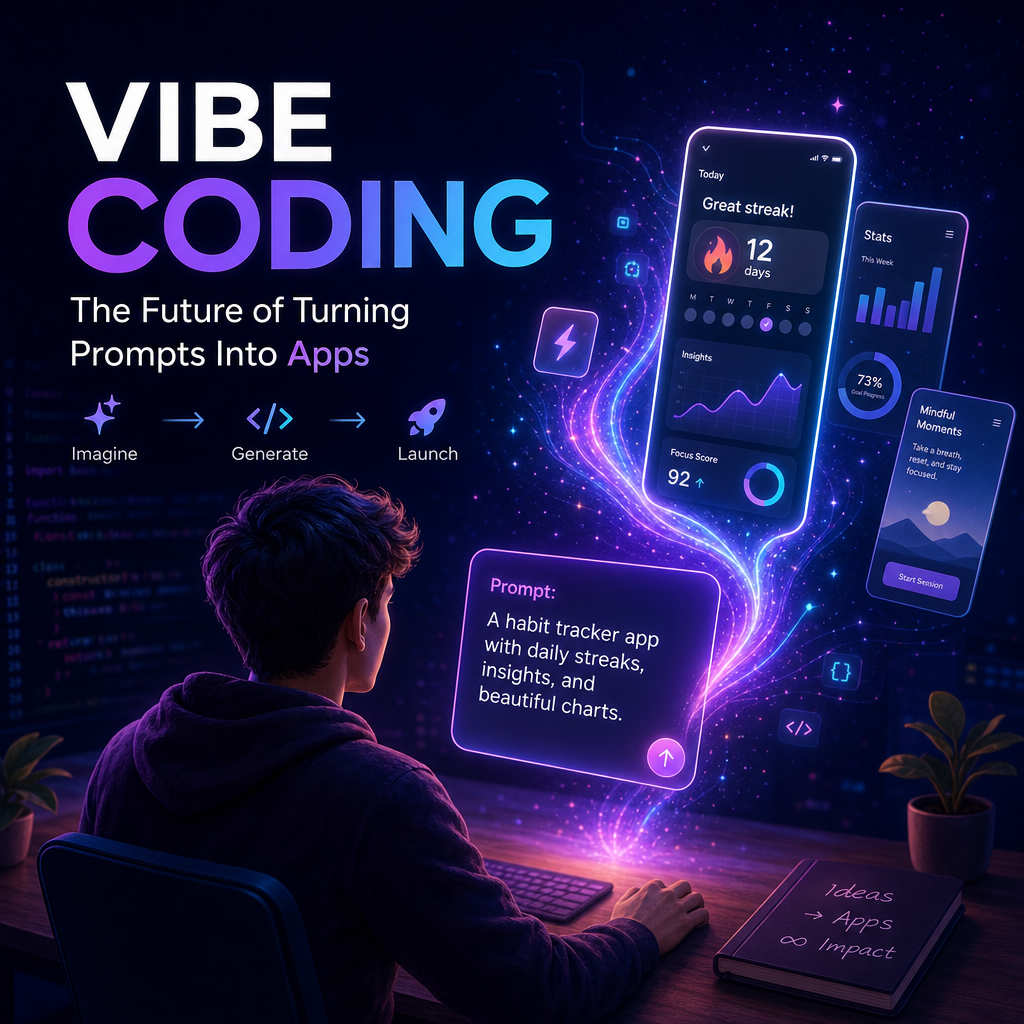
Vibe Coding: The Future of Turning Prompts Into Apps
The Future of App Creation: How Vibe Coding Turns Prompts Into Production-Ready Apps
App development is changing fast.
For years, building software meant long planning cycles, manual coding, repeated testing, and plenty of back-and-forth between product teams and developers. Today, a new approach is starting to reshape that process: vibe coding.

At its core, vibe coding is the idea that creators can describe what they want in natural language and use AI to turn those prompts into functional applications. Instead of starting with raw code, teams start with intent. That shift has major implications for startups, enterprises, and solo builders alike.
What Is Vibe Coding?
Vibe coding is a modern app creation workflow where developers use prompts, context, and iterative guidance to generate application components with AI assistance.

Rather than writing every line manually, a builder can describe features like:

- a user login flow
- a dashboard with analytics
- a payment checkout
- an admin panel with role-based access
The AI then generates code, structure, and sometimes even deployment-ready scaffolding. The developer’s role becomes more strategic: shaping requirements, validating output, refining architecture, and ensuring quality.
In other words, vibe coding does not eliminate software engineering. It changes where engineering effort goes.
Why It Matters Now
Several trends have made vibe coding possible:
Better AI code generation
Large language models are now capable of producing full-stack code across popular frameworks, APIs, and databases. They can understand instructions, follow patterns, and revise outputs based on feedback.
Faster product expectations
Businesses no longer want to wait months to test an idea. They want prototypes in days and polished MVPs in weeks. Vibe coding supports that speed.
Lower barriers to entry
Non-technical founders, designers, and operators can now participate earlier in the build process. They may not replace experienced developers, but they can help shape working software much faster than before.
How Prompts Become Production-Ready Apps
The phrase “prompts into production-ready apps” sounds simple, but the process usually happens in layers.
1. Defining the outcome
Everything starts with a clear prompt. Good prompts include goals, target users, required features, preferred frameworks, data models, and design expectations.
For example, instead of saying “build a task app,” a stronger instruction would be:
Build a SaaS task management app for small teams using Next.js and Supabase, with user authentication, Kanban boards, due dates, notifications, and Stripe billing.
That level of clarity gives the AI a much better starting point.
2. Generating the app foundation
Once the scope is defined, AI can produce:
- frontend components
- backend routes
- database schemas
- API integrations
- authentication flows
- testing boilerplate
This dramatically shortens the time between idea and usable prototype.
3. Refining through iteration
Vibe coding works best as a conversation, not a one-shot command.
Developers review the output, identify gaps, and prompt for improvements such as:
- better error handling
- stronger security rules
- cleaner UI states
- more scalable architecture
- improved performance
This iterative loop is where raw generation becomes reliable product development.
4. Hardening for production
Production-ready apps still require human oversight.
Teams need to verify:
- code quality
- security practices
- compliance requirements
- database integrity
- test coverage
- monitoring and deployment setup
Vibe coding can speed up delivery, but shipping confidently still depends on strong engineering judgment.
The Biggest Benefits of Vibe Coding
The rise of vibe coding is not just about convenience. It creates practical advantages across the entire software lifecycle.
Faster prototyping
Ideas that once took weeks to validate can now be turned into working demos in a day or two.
More creative experimentation
Because the cost of trying something new is lower, teams can test more features, interfaces, and business models.
Better collaboration
Product managers, designers, and developers can work from the same prompt-driven starting point. That reduces ambiguity and speeds alignment.
Higher leverage for developers
Engineers spend less time on repetitive scaffolding and more time on architecture, integration, and optimization.
Where Vibe Coding Still Falls Short
Despite the excitement, vibe coding is not magic.
AI-generated apps can look polished while hiding issues under the surface. Common risks include:
- inconsistent code structure
- security vulnerabilities
- inefficient queries
- missing edge cases
- poor long-term maintainability
This is especially important for teams building fintech, healthcare, or enterprise systems where reliability matters more than speed alone.
The future of app creation will not belong to teams that generate the most code. It will belong to teams that can guide, review, and improve AI output effectively.
What Developers Need to Learn Next
As vibe coding becomes more common, the most valuable skills are evolving.
Prompt design
Clear instructions are becoming just as important as clean syntax. Developers who can communicate requirements precisely will get better results.
System thinking
AI can generate features, but humans still need to design scalable systems, data flows, and long-term architecture.
Critical review
Knowing how to inspect generated code, catch weak patterns, and enforce standards will be essential.
A New Era of Building Software
Vibe coding represents a major shift in how software gets made. It turns natural language into momentum, helping teams move from concept to execution much faster than traditional workflows allow.
But the real promise is bigger than speed.
The future of app creation is about making software development more accessible, more collaborative, and more responsive to ideas. When paired with solid engineering practices, vibe coding can help transform prompts into production-ready apps that are not only fast to build, but genuinely valuable to use.
That is why vibe coding is more than a trend. It is quickly becoming a new layer in the modern development stack.