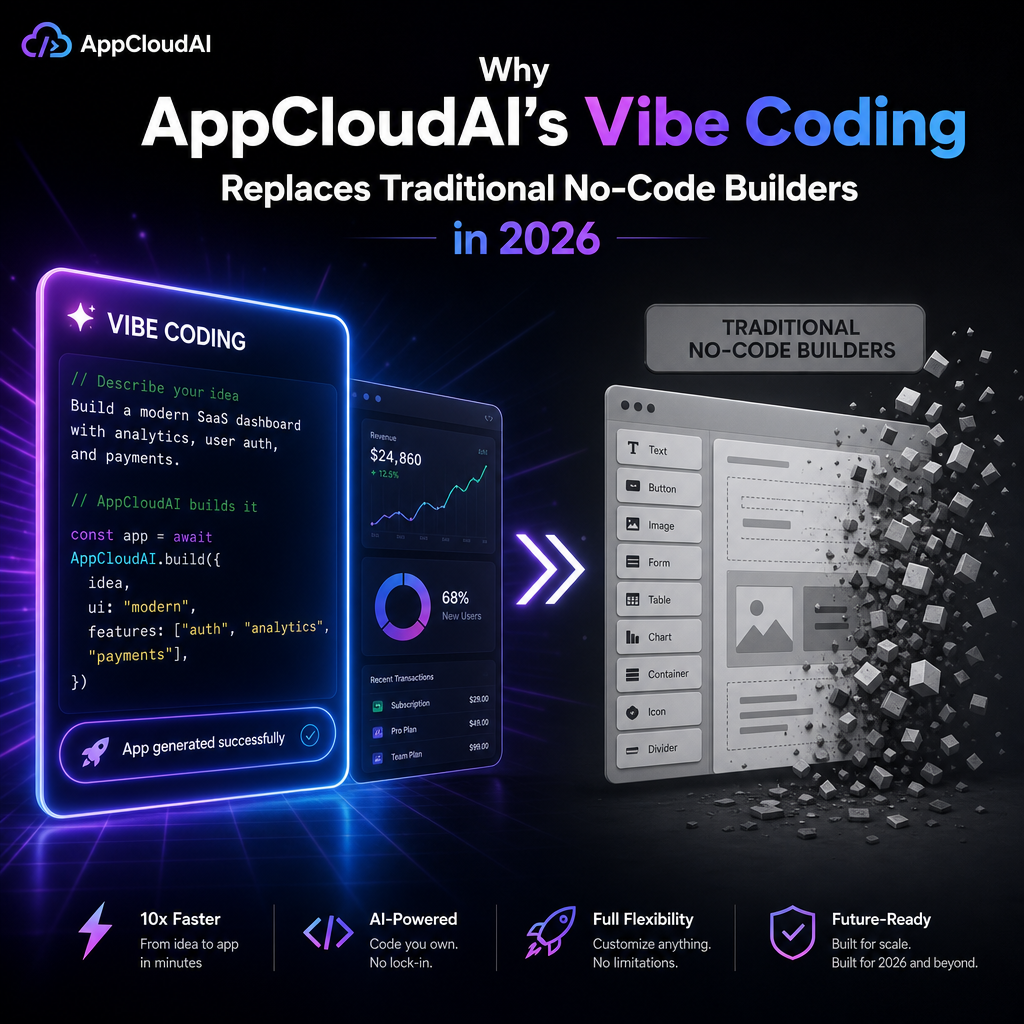
Why AppCloudAI’s Vibe Coding Replaces Traditional No-Code Builders in 2026
Why AppCloudAI’s Vibe Coding Is Replacing Traditional No-Code Builders in 2026
The no-code movement changed how people build software. It opened the door for founders, marketers, operations teams, and creators to launch apps without hiring full development teams. But in 2026, the conversation is shifting.
Traditional no-code builders are no longer the most exciting option. Instead, AppCloudAI’s Vibe Coding is becoming the preferred way to build modern apps faster, with less friction and far more flexibility.

So what changed?
The Limits of Traditional No-Code Builders
No-code tools were designed to simplify app creation through visual editors, drag-and-drop blocks, and prebuilt templates. That worked well for simple workflows and basic internal tools.

But as businesses grew, the cracks became obvious.

Common problems with traditional no-code platforms
- Rigid templates that are hard to customize
- Complex logic hidden behind messy visual workflows
- Limited control over performance and scalability
- Frustrating integrations with modern AI tools
- Design systems that often make apps look generic
- Difficulty moving from prototype to production-grade product
Many teams discovered that “easy to start” did not always mean “easy to scale.” After a certain point, they either had to compromise on features or rebuild everything from scratch.
That is exactly where AppCloudAI’s Vibe Coding enters the picture.
What Is AppCloudAI’s Vibe Coding?
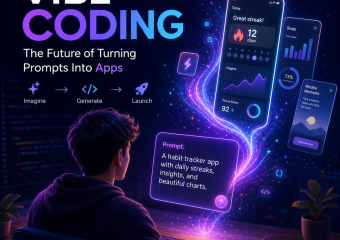
AppCloudAI’s Vibe Coding is a new way of building software that feels more natural than traditional no-code development. Instead of assembling apps piece by piece through dozens of manual clicks, users describe what they want, refine it conversationally, and let AI generate the structure, logic, and interface.
It is not just prompt-based app generation. It is an interactive building experience where intent matters more than tool familiarity.
With Vibe Coding, creators can move from idea to working product by focusing on outcomes:
- What the app should do
- How users should experience it
- Which workflows need to be automated
- What data and integrations are required
That shift is why so many teams are moving away from older no-code builders in 2026.
Why Vibe Coding Feels More Natural
Traditional no-code platforms often replace programming with visual complexity. You may not write code, but you still need to think like a systems architect.
Vibe Coding reduces that burden.
Instead of manually connecting every condition, component, and database action, users can explain what they need in plain language. The platform interprets the request, builds the underlying logic, and offers editable outputs.
This makes software creation feel less like configuration and more like collaboration.
What makes the experience different
1. Faster app creation
AppCloudAI’s Vibe Coding dramatically cuts build time. A feature that once required hours of setting up workflows, testing conditions, and adjusting layouts can now be created in minutes.
That speed matters in 2026, when teams are expected to experiment quickly and launch continuously.
2. Better customization
Old no-code systems tend to funnel users into platform-specific patterns. Vibe Coding gives users more freedom to shape app behavior, interfaces, and automation without fighting rigid builders.
The result is software that feels tailored, not templated.
3. Easier iteration
Apps rarely come out perfect on the first try. Traditional builders make changes tedious, especially when logic is buried across multiple visual layers.
With Vibe Coding, iteration is conversational. You can refine workflows, change copy, adjust onboarding, or add features without rebuilding major sections by hand.
AI-Native Development Is Winning
One major reason AppCloudAI’s Vibe Coding is replacing traditional no-code builders is that it was designed for an AI-first world.
Older platforms were built before generative AI became central to product development. As a result, many of them treat AI as an add-on.
AppCloudAI treats AI as the engine.
This changes everything:
- Interfaces can be generated and improved dynamically
- Workflows can be suggested automatically
- Data models can adapt to project needs
- Repetitive setup work is minimized
- Product decisions can be tested more quickly
In 2026, teams do not just want a visual builder. They want a platform that actively helps them think, build, and improve.
From Prototype to Production Without the Usual Rebuild
A major frustration with traditional no-code tools is that successful prototypes often outgrow the platform. Teams then face a painful decision: keep patching limitations or rebuild elsewhere.
AppCloudAI’s Vibe Coding reduces that gap.
Because the system is designed to generate more robust app structures from the beginning, businesses can move from concept to real deployment with fewer compromises. That means less technical debt, fewer workarounds, and a smoother path to scale.
For startups, this shortens time to market.
For enterprise teams, it reduces bottlenecks.
For solo founders, it removes the need to choose between speed and quality.
Why 2026 Is the Tipping Point
This shift is not happening just because AI is trendy. It is happening because expectations have changed.
Today’s builders want:
- More speed
- Less manual configuration
- Smarter automation
- Better-looking products
- Greater flexibility
- Tools that evolve with their ideas
Traditional no-code builders solved the problem of access. AppCloudAI’s Vibe Coding solves the next problem: momentum.
It helps people keep building without getting trapped by the platform itself.
Final Thoughts
No-code was a major step forward, but it was never the final form of software creation. In 2026, AppCloudAI’s Vibe Coding is replacing traditional no-code builders because it offers a more intelligent, fluid, and scalable way to turn ideas into apps.
The biggest advantage is not just that it is faster.
It is that it feels closer to how people actually think.
And when building software starts to feel that natural, the old way quickly begins to look outdated.