
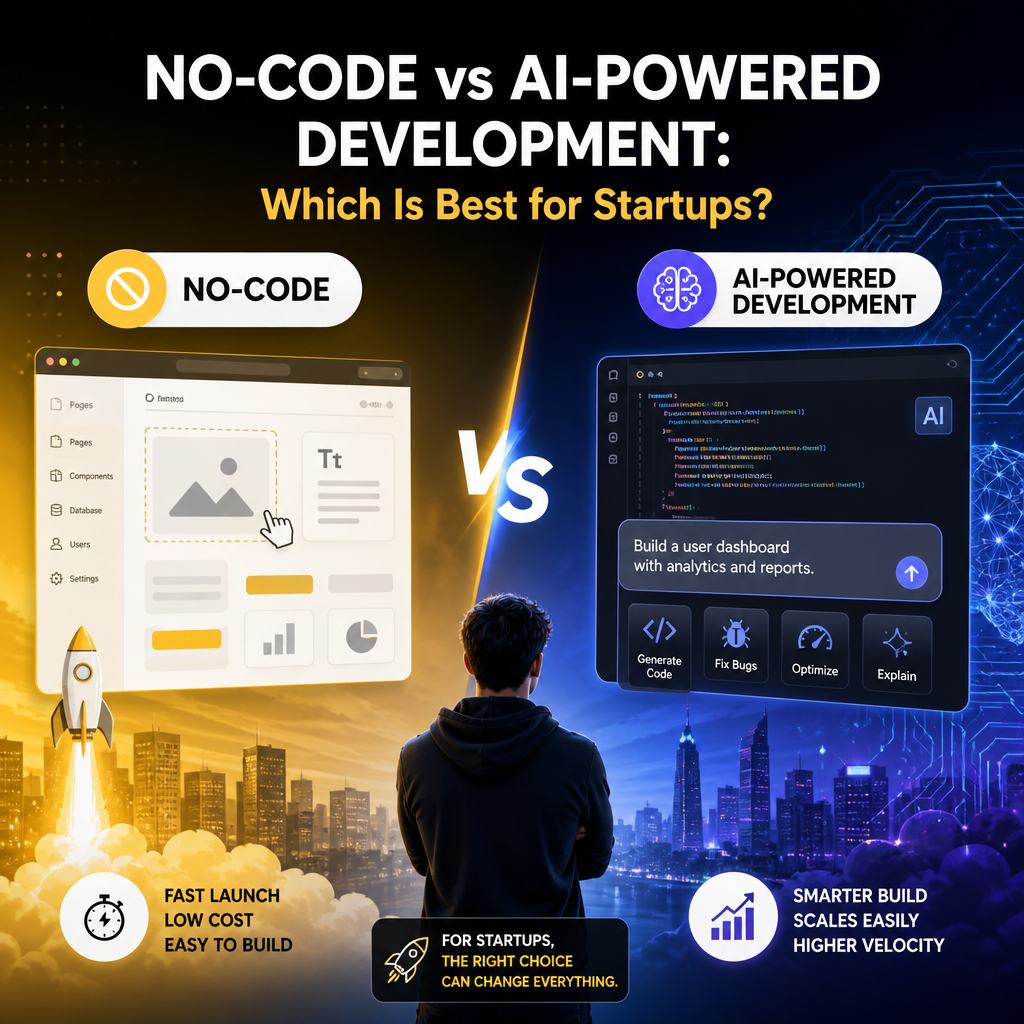
No-Code vs AI-Powered Development: Which Is Best for Startups?
No-Code vs. AI-Powered Development: Which Is Better for Startups?
Startups need to build and test products quickly, often with limited budgets and small teams. No-code platforms and AI-powered development tools can both speed up the process, but they solve different problems. The right choice depends on what you’re building, who will maintain it, and how much flexibility you’ll need as the business grows.
What Is No-Code Development?
No-code platforms let people create websites, apps, and workflows through visual interfaces rather than traditional programming. Users assemble components, configure settings, and connect services using menus and drag-and-drop tools.

They’re especially useful for:
- Building landing pages and internal dashboards
- Automating routine business processes
- Creating simple customer portals or prototypes
- Testing an idea before investing in a custom product
Because no-code tools reduce the need for specialized developers, they can help founders launch an early version of a product quickly. Many platforms also include hosting, templates, and integrations, simplifying setup.

However, no-code does not mean no limitations. A product may become difficult to customize when its requirements outgrow the platform. Pricing can also rise with usage, and moving data or functionality to another system may take effort.

What Is AI-Powered Development?
AI-powered development uses artificial intelligence to assist with software creation. Depending on the tool, it may generate code from written instructions, suggest changes, explain errors, or help developers test and document an application.
AI can support both technical and nontechnical teams, but it does not necessarily eliminate the need for coding expertise. The generated code may need review, debugging, and security checks. Teams also need to provide clear instructions and verify that the result behaves as intended.
AI-powered development can be useful for:
- Producing a working prototype from a product description
- Helping developers write or review code faster
- Generating tests, documentation, or repetitive components
- Exploring features before committing to a full implementation
Unlike a typical no-code platform, AI-assisted tools may offer greater flexibility when they generate editable code. That flexibility comes with added responsibility: someone must understand, maintain, and secure the application.
No-Code vs. AI-Powered Development: Key Differences
The main difference is how much control the team has over the underlying product. No-code tools provide a structured environment with predefined components. AI tools can help create more customized software, but the result may require technical oversight.
| Consideration | No-code | AI-powered development |
|---|---|---|
| Getting started | Often straightforward | Depends on the tool and task |
| Coding knowledge | Usually minimal | Helpful, especially for production apps |
| Customization | Limited by platform | Potentially broader |
| Maintenance | Managed partly by the platform | Depends on the code and team |
| Best suited for | Simple products and workflows | Custom features and faster coding |
Neither approach guarantees a successful product. Both can shorten development time, but startups still need to validate the problem, understand customer needs, and make thoughtful product decisions.
Which Option Is Better for a Startup?
Choose no-code when speed and simplicity matter most
No-code is often a good fit if you’re testing demand, building a straightforward product, or automating internal work. It lets a small team create something usable without first hiring a full engineering team.
For example, a founder might use a no-code tool to launch a booking portal or customer survey workflow. If customers respond well, the startup can decide whether to expand the setup or rebuild parts of it later.
Choose AI-powered development when flexibility matters
AI-powered development may be a better choice when the product needs unique features, specialized integrations, or more control over its architecture. It can help experienced developers move faster, while still allowing them to inspect and adapt the code.
For a startup building a complex marketplace or data-heavy service, AI may support development—but it shouldn’t replace careful technical planning. Code quality, privacy, security, and future maintenance still matter.
A Practical Approach: Combine Both
Startups don’t always have to choose one method for everything. A team might use no-code for a landing page, sales operations, or an early prototype, while using AI to assist with custom application code. This can keep initial costs manageable without locking every part of the business into one platform.
Before choosing, consider:
- How complex is the product? Simple workflows favor no-code; unusual requirements may call for custom code.
- Who will maintain it? Match the tool to the skills available now and likely to be available later.
- What happens if you grow? Check usage limits, pricing, data access, and options for migration.
- How sensitive is the data? Review security controls and privacy obligations before launch.
The Bottom Line
No-code is often the faster route for simple products, internal tools, and early experiments. AI-powered development can offer more flexibility, particularly when developers need to build custom software efficiently. For many startups, the best answer is a thoughtful combination: use no-code where requirements are standard and AI-assisted coding where differentiation or control matters most. Start with the simplest approach that meets your needs, then reassess as customers and product requirements evolve.
