
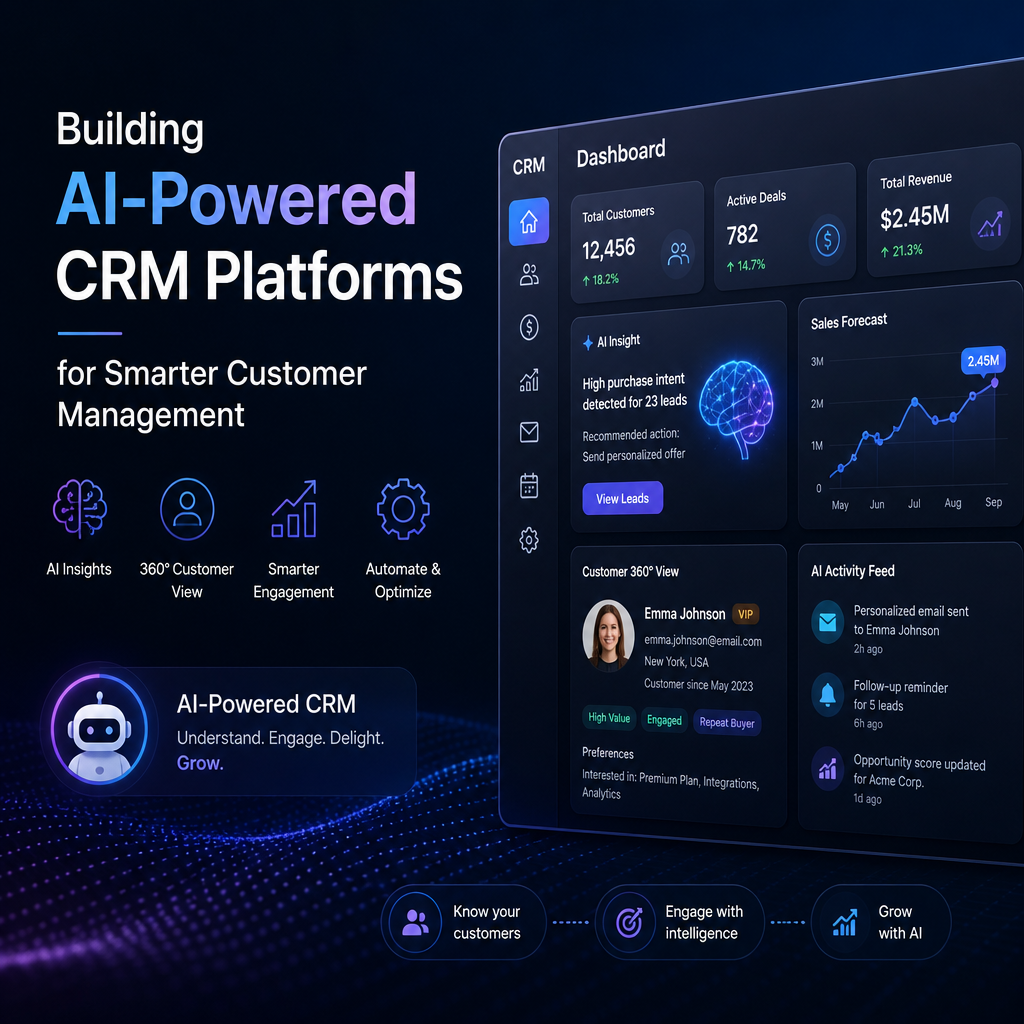
Building AI-Powered CRM Platforms for Smarter Customer Management
Building CRM Platforms with AI: From Data to Better Decisions
Customer relationship management platforms have evolved beyond contact databases and sales pipelines. Today, building CRM platforms with AI means creating systems that help teams understand customer needs, prioritize work, and respond more effectively. The best results come not from adding AI everywhere, but from connecting useful intelligence to well-designed workflows.
An AI-enabled CRM can summarize conversations, forecast opportunities, recommend next steps, and surface customer risks. To make those features dependable, organizations need a thoughtful foundation of data, user experience, and oversight.

Start With Clear Business Goals
Before selecting models or tools, identify the problems the CRM should solve. A sales team might need more accurate forecasts, while a service team may want to reduce response times or spot recurring complaints.
Choose a small number of measurable outcomes, such as:

- Shorter time spent entering and reviewing customer information
- Faster responses to common support requests
- More reliable lead prioritization
- Improved forecast accuracy
- Earlier identification of customers at risk of leaving
These goals help teams distinguish useful AI features from impressive-sounding additions. They also provide a way to evaluate the platform after launch.

Build on Reliable Customer Data
AI depends on the information it can access. If customer records are duplicated, outdated, or inconsistent, model-generated recommendations may be equally unreliable.
A strong CRM foundation brings relevant information together, including account details, interactions, purchases, support history, and marketing preferences. Teams should define shared standards for fields such as customer status, industry, and opportunity stage. Data validation and deduplication processes help maintain quality over time.
It is also important to decide which information the AI can use. Sensitive or irrelevant data should not be exposed simply because it is available. Clear access rules make the system safer and help employees understand why certain insights appear.
Connect Systems Carefully
Many organizations store customer information across email platforms, service desks, billing software, and analytics tools. Integrations can create a more complete picture, but they should be designed around specific use cases.
Use stable APIs and documented data flows wherever possible. Track when information was last updated, and establish what happens when connected systems disagree. A customer record should not become less trustworthy just because more sources were added.
Design AI Features Around Daily Work
AI is most valuable when it appears where employees already make decisions. A sales representative could see a concise account summary before a meeting. A support agent might receive a suggested response alongside relevant policy information. A manager could review a forecast that explains the factors behind its estimate.
Useful CRM features often include:
- Conversation summaries: Turn calls, emails, or meetings into concise notes.
- Recommendations: Suggest follow-up tasks based on customer activity.
- Predictive scoring: Help prioritize leads or identify accounts that may need attention.
- Natural-language search: Let employees find records or insights using everyday questions.
- Drafting assistance: Create editable first drafts for emails, case notes, or reports.
Keep recommendations explainable where possible. Showing the source activity or key factors behind a prediction helps employees assess whether it makes sense. AI should support professional judgment, not silently replace it.
Choose an Architecture That Can Adapt
A modern AI CRM may combine application services, a customer data layer, analytics, and one or more AI models. The architecture should make it possible to update models or integrations without rebuilding the entire platform.
For generative AI features, retrieval-based approaches can help ground responses in approved company information. Instead of relying only on a model’s general training, the system retrieves relevant documents or CRM records and uses them as context. This can improve relevance, though it does not remove the need to check outputs.
Plan for monitoring from the beginning. Track response quality, latency, usage, and cost. Keep audit logs for important AI-assisted actions, and provide a way for users to report inaccurate or inappropriate results.
Protect Trust Through Governance
CRM platforms contain personal and commercially sensitive information. AI capabilities should follow privacy, security, and retention policies already established by the organization.
Use role-based permissions so employees see only the data they are authorized to access. Review how information is sent to external model providers, whether it is retained, and whether it may be used for training. Make AI-generated content identifiable when appropriate, especially when employees need to verify it before sharing.
Human review is particularly important for decisions with significant consequences, such as pricing, eligibility, or account prioritization. Teams should test systems for bias and monitor whether performance differs across customer groups.
Launch in Stages and Keep Improving
A pilot is usually more effective than a broad rollout. Select one workflow, involve the employees who will use it, and compare results against a baseline. Gather feedback on accuracy, clarity, and how well the feature fits the work.
Then refine the data, interface, and instructions before expanding to other teams. Ongoing maintenance matters: customer behavior changes, policies evolve, and models can become less effective over time.
Building CRM platforms with AI is ultimately an exercise in combining sound software design with practical customer insight. When the data is dependable, the features match real workflows, and people remain accountable for important decisions, AI can make a CRM more useful without making it harder to trust.
