Why Vibe Coding Is Disrupting Traditional Software Development
Why Vibe Coding Is Disrupting Traditional Software Development
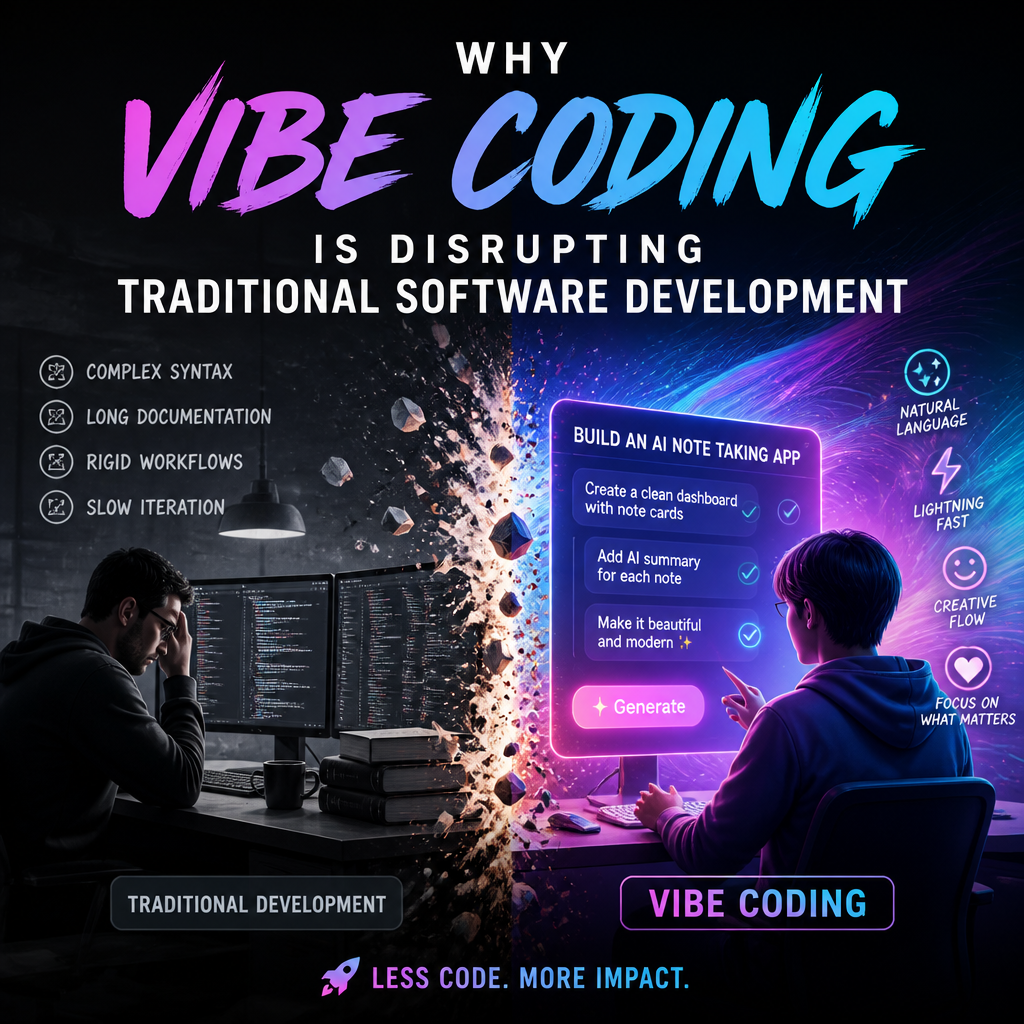
For decades, building software followed a familiar path: define requirements, write code, test it, and refine it through repeated development cycles. Today, AI tools are changing that process. A growing approach known as vibe coding lets people describe what they want in everyday language and use AI to generate or modify the code.
The term captures a shift in emphasis. Instead of manually specifying every technical detail, a developer communicates the desired outcome, reviews what the AI produces, and guides it toward a working result. This approach is disrupting traditional software development—not by making engineering expertise irrelevant, but by changing where people spend their time and who can participate.

What Is Vibe Coding?
Vibe coding is a conversational style of software development in which a person uses AI to create, explain, or revise code. The user might ask for a landing page, a small business app, or a feature that organizes data. The AI then generates code, which the user can test and adjust with further prompts.
The process often looks less like writing a program line by line and more like directing a collaborator:

- Describe the goal in plain language.
- Ask the AI to generate a first version.
- Try the result and identify problems.
- Request changes, review the code, and repeat.
This can make experimentation faster. A prototype that once required hours of setup may be ready in minutes, especially when the project is small and the requirements are clear.

Why It Challenges the Traditional Workflow
Faster From Idea to Prototype
Traditional software projects often involve a significant gap between an idea and a usable demonstration. Teams may need to translate requirements into technical plans, create the project structure, and build basic features before anyone can see the result.
Vibe coding can shorten that gap. A founder can sketch an early product concept, a designer can test an interaction, or a developer can build a rough internal tool without starting from a blank editor. The speed is valuable because it makes testing ideas cheaper: teams can discover what works before investing heavily in a polished product.
A Lower Barrier to Entry
AI coding tools also allow people with limited programming experience to make simple websites, scripts, and prototypes. They may not understand every line of code, but they can describe a goal, evaluate the output, and iterate.
That accessibility is disruptive because software creation is no longer limited to people who can independently write every part of a program. Subject-matter experts can contribute more directly. A teacher might build a classroom resource, or a small business owner might automate a repetitive task without waiting for a dedicated engineering team.
A Different Role for Developers
Rather than eliminating developers, vibe coding can shift their work toward higher-level decisions. Developers may spend less time on routine scaffolding and more time on architecture, integration, testing, security, and reviewing AI-generated code.
This changes the skills that matter. Clear communication, system-level thinking, and the ability to spot flawed assumptions become increasingly important. So does technical judgment: an application can appear to work while still containing fragile logic or serious security problems.
The Risks Behind the Speed
Vibe coding is not a shortcut around software quality. AI-generated code can include bugs, outdated patterns, insecure dependencies, or features that do not match the user’s actual needs. A polished interface may disguise a weak foundation.
The risks increase when someone cannot evaluate the output. A small prototype might be acceptable with minimal review, but software that handles payments, personal information, or critical operations requires careful engineering. Human review, automated tests, access controls, and security checks remain essential.
There is also a maintenance challenge. Code created through rapid prompts can become difficult to understand if no one documents its structure or tracks changes. Teams still need standards for version control, testing, and ownership—even when AI produces much of the implementation.
A New Development Model, Not a Replacement
The biggest disruption may be cultural. Traditional development often treated coding as the main act of software creation. Vibe coding places more emphasis on describing problems, testing possibilities, and evaluating results. The code still matters, but generating it is becoming less of a barrier.
For experienced teams, AI can speed up repetitive work and help explore alternatives. For beginners, it can turn ideas into tangible experiments. In both cases, the strongest results come from combining AI’s speed with human context and technical oversight.
Vibe coding is therefore best understood as an evolution in how software is built. It makes the first draft easier to create, but it does not remove the need to ask whether the draft is reliable, secure, and useful. Traditional engineering principles remain relevant; the difference is that more people can now take part in the process, and developers can focus more of their expertise on making software work well beyond the initial demo.