
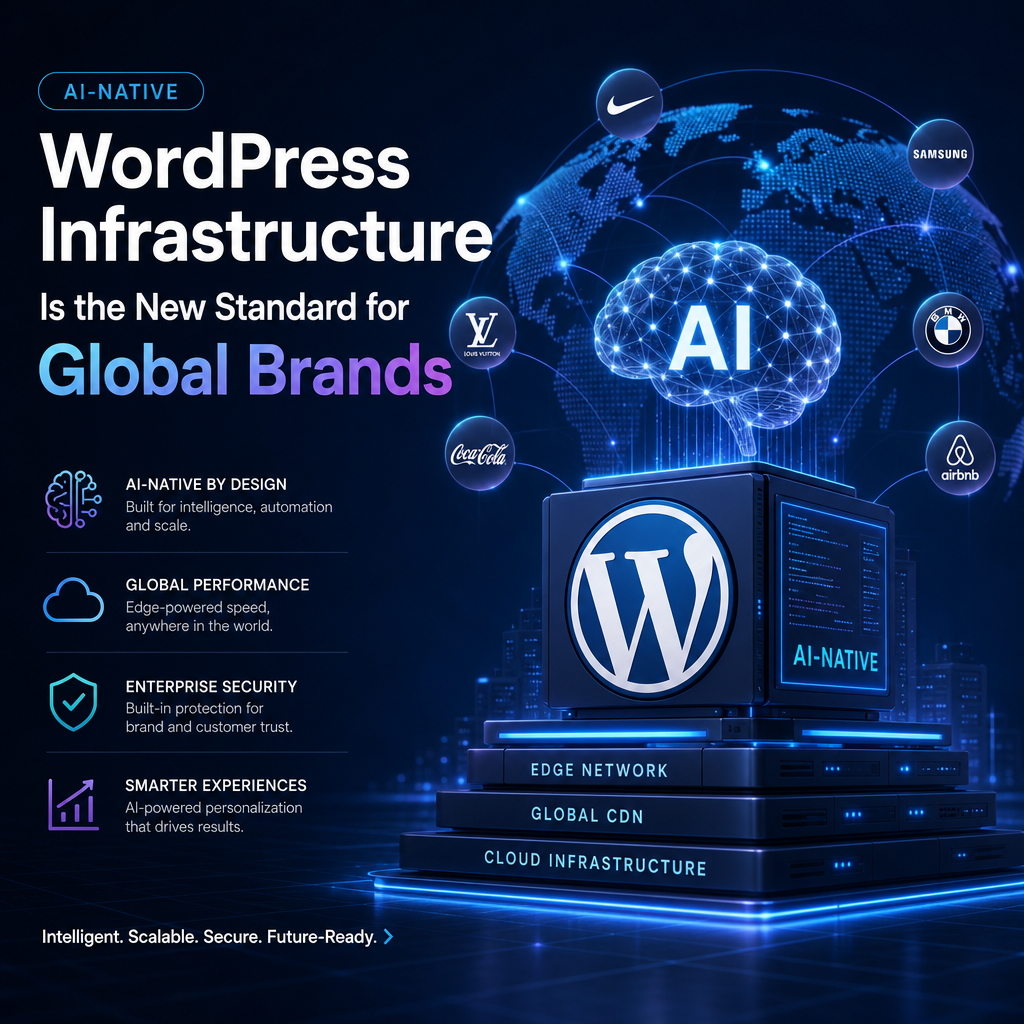
Why AI-Native WordPress Infrastructure Is the New Standard for Global Brands
Why AI-Native WordPress Infrastructure Is the New Standard for Global Brands
Global brands no longer treat their websites as simple publishing platforms. Today, a WordPress site is a revenue engine, a campaign hub, a customer experience layer, and often the center of an entire digital ecosystem.
That shift is exactly why AI-Native WordPress Infrastructure is becoming the new standard.

Traditional hosting and maintenance models were built for a slower web. They focused on uptime, storage, and basic performance. Modern brand websites need much more. They need intelligent automation, faster content operations, stronger security, better scalability, and the ability to support global audiences without friction.
The Web Demands More Than Traditional WordPress Hosting
For enterprise and multi-region brands, the pressure is constant.

Teams are expected to:

- launch content faster
- personalize digital experiences
- maintain peak performance during traffic spikes
- protect against evolving threats
- optimize conversion paths continuously
Standard infrastructure can keep a site online, but that is no longer enough. Global brands need systems that actively improve how WordPress operates. That is where AI-native architecture stands apart.
What AI-Native WordPress Infrastructure Actually Means
AI-native infrastructure is not just “hosting with some AI features added on.” It is an environment where intelligence is built into the platform itself.
That means AI can support core functions like:
- automatic performance tuning
- predictive scaling during traffic surges
- anomaly detection for security events
- smart caching and content delivery optimization
- workflow automation for developers and marketers
- data-driven recommendations for site improvements
Instead of relying only on manual monitoring and reactive support, brands gain infrastructure that can detect patterns, anticipate issues, and respond faster.
Why Global Brands Are Moving in This Direction
Speed at Scale
Site speed is a brand issue, not just a technical issue. A slow website impacts ad performance, SEO, conversion rates, and customer trust.
AI-native systems can analyze traffic behavior, optimize resource allocation, and improve caching decisions in real time. This helps global brands deliver fast experiences across regions, devices, and traffic conditions.
For companies operating in multiple markets, that level of responsiveness is critical.
Smarter Security
Enterprise WordPress websites are frequent targets for bots, malware, credential attacks, and exploit attempts. Traditional security tools often depend on static rules and delayed intervention.
AI-native WordPress Infrastructure improves this model by identifying unusual behavior earlier. It can spot anomalies, flag suspicious patterns, and support faster mitigation before small issues become major incidents.
For global brands, that translates into reduced risk and stronger operational resilience.
Operational Efficiency
Large organizations often manage multiple websites, regional campaigns, localization workflows, and cross-functional teams. Manual maintenance creates delays and increases the chance of errors.
AI-driven infrastructure can reduce repetitive tasks through automation, including:
- plugin and update monitoring
- performance diagnostics
- infrastructure health checks
- alert prioritization
- deployment support
This gives marketing, content, and development teams more time to focus on growth rather than routine maintenance.
AI Supports Better Content Operations Too
WordPress remains one of the best CMS platforms for publishing at scale, but the complexity of modern content operations has grown. Global brands are managing multilingual websites, dynamic landing pages, and constant content refresh cycles.
With AI-native systems, infrastructure can better support those demands by helping teams:
- identify bottlenecks in content delivery
- maintain performance as media libraries grow
- improve uptime during major launches
- support integration-heavy publishing workflows
The result is not just a faster backend. It is a more reliable environment for producing and distributing content worldwide.
A Better Foundation for Personalization
Customers expect relevant digital experiences. Brands want to tailor content by market, audience segment, behavior, or campaign source.
That requires infrastructure capable of handling more complexity without sacrificing speed. AI-native platforms help by managing performance intelligently even as personalization layers increase.
In other words, brands do not have to choose between richer experiences and technical stability. They can support both.
Why “Native” Matters
Many providers now promote AI features, but there is a difference between AI as an add-on and AI as part of the foundation.
When AI is native to the infrastructure, it can influence how the platform performs at every level. It is not isolated in one dashboard or one feature set. It becomes part of how the website is monitored, protected, optimized, and scaled.
That deeper integration creates better outcomes because insights are connected directly to action.
What Global Brands Should Look For
Not every platform offering automation qualifies as true AI-native infrastructure. Brands should evaluate whether a provider can deliver:
Core capabilities
- real-time performance optimization
- intelligent threat detection
- automated scaling
- actionable monitoring and reporting
- seamless support for global traffic distribution
Strategic value
- reduced operational overhead
- faster campaign launches
- stronger digital governance
- improved user experience across markets
The best solutions do not just host WordPress. They help brands run it more intelligently.
The New Standard Is Already Here
As digital expectations rise, enterprise WordPress environments need to do more than stay online. They need to adapt, learn, and optimize continuously.
That is why AI-Native WordPress Infrastructure is quickly becoming the new standard for global brands.
It offers a practical answer to the modern demands of speed, security, scale, and efficiency. And in a market where every digital interaction shapes brand perception, that advantage is no longer optional.
It is foundational.
