
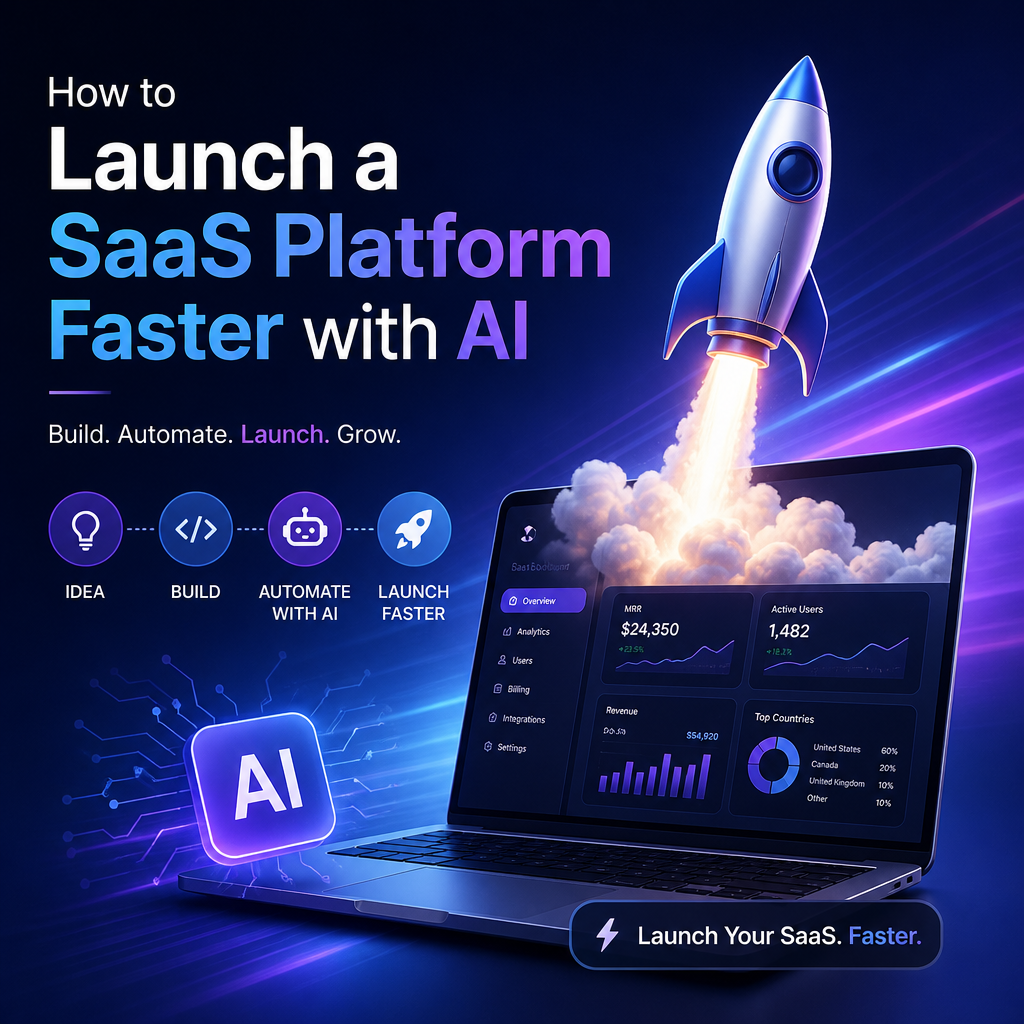
How to Launch a SaaS Platform Faster with AI
How to Launch a SaaS Platform Faster Using AI
Launching a SaaS platform can involve months of research, design, development, testing, and marketing. Artificial intelligence can speed up many of these steps—but it works best as a practical assistant, not a replacement for product judgment.
To launch a SaaS platform faster using AI, focus on tasks where automation and rapid analysis save time while keeping important decisions in human hands.

Start With a Sharper Product Idea
Before writing code, use AI to organize what you know about your target customers and the problem you want to solve. Summarize interview notes, group common pain points, and compare potential user segments. You can also ask an AI tool to identify assumptions that need validation.
Treat its responses as hypotheses, not market research. Verify important claims through customer conversations, competitor analysis, and real-world testing.

Define a Minimum Viable Product
AI can help turn a broad idea into a smaller, testable product scope. Describe the customer, their problem, and the outcome you want to deliver. Then ask for a list of essential features and separate them from enhancements.

A useful first-release checklist might include:
- A clear solution to one high-priority problem
- A simple onboarding flow
- Essential account and billing functions
- Basic analytics and customer support
- A way to collect user feedback
Keeping the scope narrow reduces development time and makes it easier to learn from early customers.
Speed Up Planning and Design
AI tools can help create user stories, draft product requirements, map workflows, and outline edge cases. These starting points can reduce blank-page work for product managers and developers. Review every output for accuracy, especially when it involves user permissions, billing, privacy, or regulatory requirements.
For design, AI can support early brainstorming by generating interface copy, suggesting layouts, or summarizing usability feedback. Pair these ideas with prototypes and user testing. A polished-looking screen is not necessarily an intuitive one, so observe how potential customers actually use it.
Accelerate Development Carefully
AI coding assistants can generate boilerplate, explain unfamiliar code, suggest tests, and help developers navigate large codebases. They may be especially useful for repetitive tasks such as creating basic components, documenting functions, or drafting database queries.
Use AI-generated code selectively. Before merging it:
- Check that it fits your architecture and coding standards.
- Review it for security and performance issues.
- Run automated tests and inspect edge cases.
- Confirm that licenses and data-handling practices are appropriate.
For a SaaS product, small mistakes in authentication, access control, or data isolation can affect many customers. Human code review and secure development practices remain essential.
Automate Testing and Quality Checks
Testing is a common bottleneck when teams are trying to move quickly. AI can help draft test cases from product requirements, identify likely edge cases, and summarize errors from logs. Combined with automated unit, integration, and end-to-end tests, these tools can help teams catch problems earlier.
Prioritize testing the paths that matter most to customers: signing up, completing the core task, managing an account, and paying for the service. Test accessibility, mobile usability, and failure states too. Faster releases are valuable only when the product remains reliable.
Prepare Marketing in Parallel
AI can help a small team produce early marketing assets while development is underway. Use it to draft landing-page copy, onboarding emails, help articles, and social posts. Provide clear brand guidelines and specific audience details so the content does not sound generic.
Ask real users to review messaging before launch. Their questions and language can reveal whether your value proposition is clear. Make sure marketing claims are accurate, particularly when describing AI features, expected results, or security protections.
Keep Humans in the Decision Loop
AI can accelerate research, writing, coding, and testing, but it cannot reliably determine whether customers truly want your product. It may also produce outdated, biased, or incorrect information. Protect customer data when using AI tools, and understand how each provider handles submitted content.
The fastest sustainable launch comes from combining automation with frequent feedback. Release a focused version, measure how users behave, and improve the product based on evidence. AI can shorten the path from idea to launch—but customer understanding and careful execution are what make the platform worth using.
