
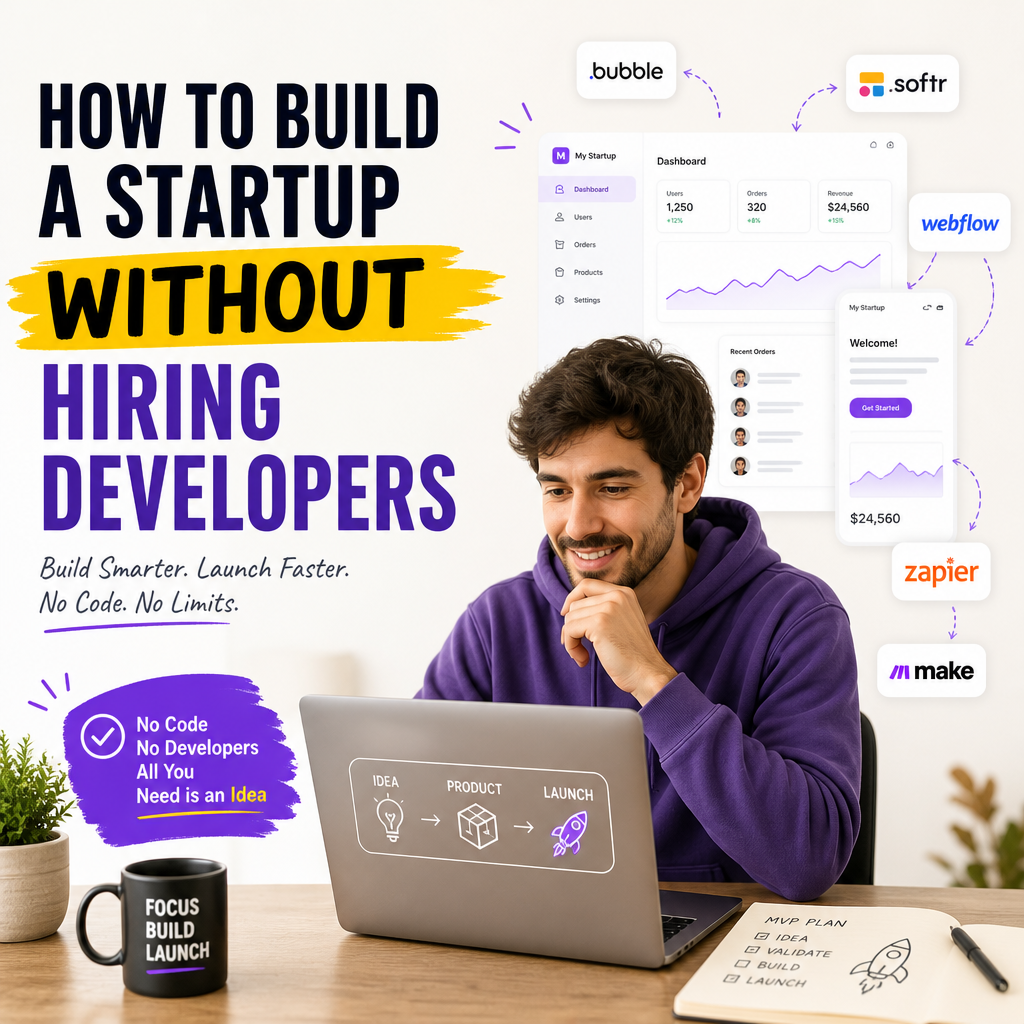
How to Build a Startup Without Hiring Developers
The Entrepreneur’s Guide to Building a Startup Without Hiring Developers
You don’t need a technical co-founder or a full engineering team to test a business idea. Today’s no-code and low-code tools let founders create websites, automate workflows, and build early product experiences with little or no programming.
Building a startup without hiring developers can help you move quickly and spend less while you learn what customers actually need. The goal isn’t to avoid developers forever. It’s to make smart progress before investing in custom software.

Start With the Problem, Not the Product
Before choosing a platform, define the problem you want to solve. Be specific about who experiences it, how they handle it today, and why existing solutions fall short.
Talk to potential customers and ask about their current behavior—not just whether they like your idea. Look for evidence that they already spend time or money addressing the problem.

Write a simple value proposition that explains:

- Who the product is for
- What problem it solves
- Why your solution is useful
This keeps you from spending weeks building features nobody needs.
Create the Simplest Useful Version
Your first product does not need every feature you imagine. It needs to help a small group of people experience the core value of your idea.
Depending on the business, an early version might be:
- A landing page with a sign-up form
- A clickable prototype that demonstrates the user journey
- A service delivered manually behind the scenes
- A basic marketplace where you match buyers and sellers yourself
- A small database and automated workflow
This “concierge” approach is especially useful when software would be expensive to build. You can perform some tasks manually, learn where customers get stuck, and automate only after a process proves valuable.
Choose Tools That Fit the Job
No-code platforms can cover many early startup needs. The right choice depends on what you’re building, your budget, and how much flexibility you need.
Common startup tools
- Websites and landing pages: Webflow, Squarespace, or WordPress
- Forms and customer intake: Tally, Typeform, or Jotform
- Databases and lightweight apps: Airtable, Glide, or Softr
- Online stores: Shopify
- Payments: Stripe or a platform’s built-in checkout
- Workflow automation: Zapier or Make
- Design and prototypes: Figma
Avoid selecting tools just because they are popular. Check whether they connect to the services you already use, support the features you need, and let you export or access your data. A convenient tool today should not trap your business tomorrow.
Build Around One Customer Journey
Map the shortest path from a customer’s problem to a useful outcome. For example, a customer might discover your service, create an account, submit a request, and receive a result.
Build and test that path before adding dashboards, social features, or advanced reporting. Each extra feature creates more work and more opportunities for confusion.
Ask a few potential users to try the product without coaching them. Watch where they hesitate, what they misunderstand, and whether they complete the task. Use those observations to improve the experience.
Keep Quality and Risk in View
A no-code startup still needs to earn customer trust. Make sure your product works reliably, communicates clearly, and handles information responsibly.
Before launch:
- Test the experience on mobile and desktop.
- Check payment, email, and form workflows from end to end.
- Use strong passwords and enable two-factor authentication.
- Collect only the personal data you genuinely need.
- Publish clear privacy, refund, and service policies where relevant.
- Keep backups of important data and records.
No-code tools can simplify operations, but they don’t remove your responsibility for security, privacy, or customer support.
Know When to Bring in a Developer
Building without developers is a way to reduce uncertainty, not a rule against technical help. Consider hiring a developer or technical consultant when your product requires custom functionality, has growing performance problems, handles sensitive data, or depends on integrations your tools cannot support.
You may also need help when platform fees rise, workarounds become difficult to manage, or the product’s limitations are slowing growth. By then, you’ll have customer feedback and real usage data to guide the investment.
Build, Learn, and Adapt
A successful startup is not defined by how much custom software it launches. It’s defined by how effectively it solves a real problem and learns from customers. Start with the tools and skills available to you, keep the first version focused, and measure whether people return, pay, or recommend it.
Building a startup without hiring developers is most effective when you treat it as a disciplined experiment. Prove the demand first, then invest in technology when the evidence—and the business—are ready.
