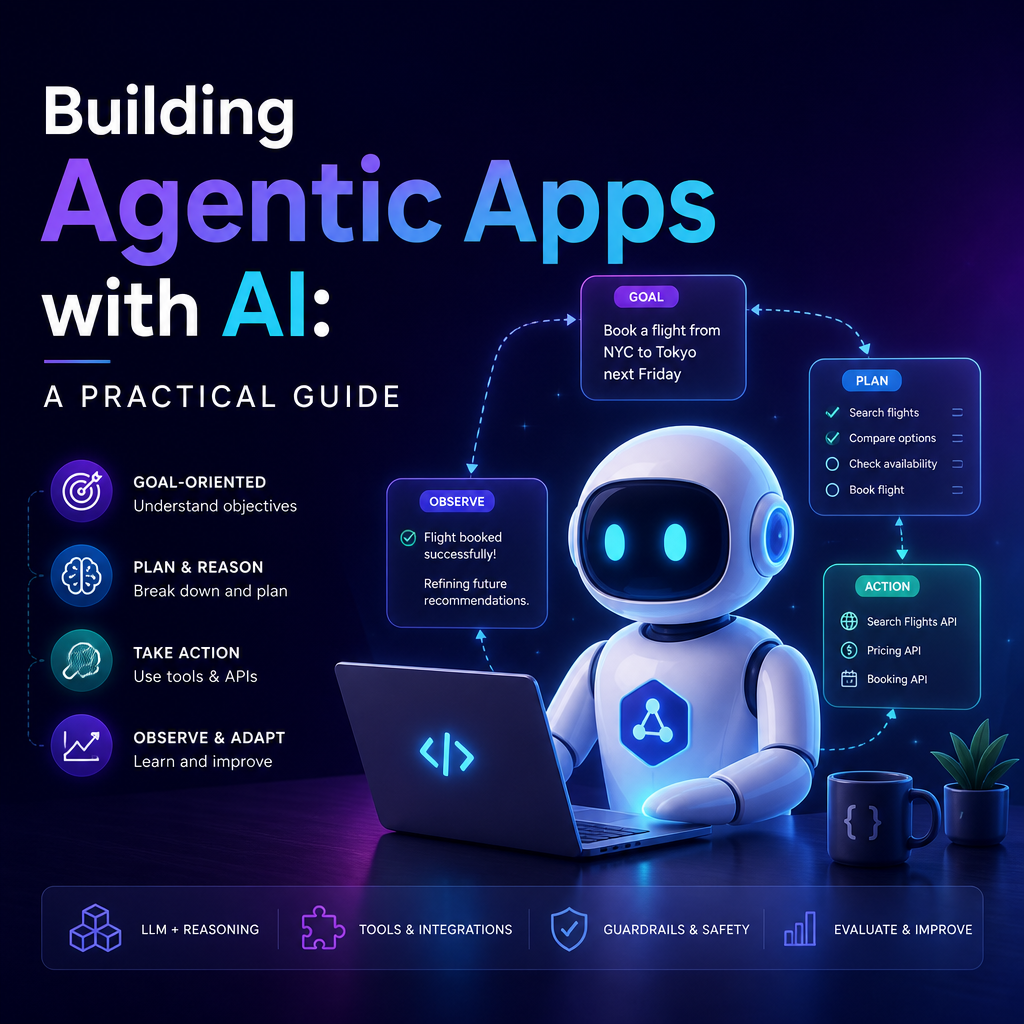
Building Agentic Apps with AI: A Practical Guide
Building Agentic Apps with AI
AI applications are moving beyond answering questions and generating text. Agentic apps can plan steps, use tools, track progress, and adjust their approach to reach a goal. That makes them useful for tasks such as researching a topic, processing support requests, reviewing documents, or coordinating routine workflows.
But adding an AI model does not automatically make an app agentic—or reliable. Building agentic apps with AI requires thoughtful design around goals, tools, context, permissions, and oversight.

What Makes an App Agentic?
A conventional AI feature typically responds to a prompt in one step. An agentic app can work through a sequence of actions. It may interpret a request, decide what information it needs, call a tool, evaluate the result, and choose what to do next.
For example, a travel-planning app might compare flight options, check a user’s calendar, and prepare an itinerary. The model helps determine the next step, while the app’s tools provide access to specific services and data.

Agentic behavior does not mean giving an AI unlimited independence. The most effective systems use defined objectives and clear boundaries. They should know what they are allowed to do, what requires approval, and when to stop.

Start With a Bounded Use Case
The best starting point is a repetitive task with a clear outcome and manageable risks. Avoid beginning with a broad goal such as “run my business.” Instead, define a specific workflow, such as summarizing customer feedback and tagging common themes for a human reviewer.
Before development, answer a few practical questions:
- What outcome should the app produce?
- Which steps can be automated safely?
- What data and tools does the app need?
- Which actions require human approval?
- How will success and failure be measured?
A narrow use case makes it easier to test the app, identify edge cases, and establish whether AI is actually useful.
Design the Agent’s Tools and Permissions
Tools turn an AI system’s decisions into actions. These may include search, databases, calendars, internal APIs, or document processors. Each tool should have a clear purpose and a carefully limited scope.
Use least-privilege access: give the agent only the permissions it needs. A system that summarizes invoices, for instance, may need to read invoice records but should not be able to issue payments. For actions with financial, legal, or account consequences, require confirmation before execution.
Tool descriptions matter, too. They should explain what a tool does, what inputs it expects, and what its output means. Clear interfaces reduce incorrect calls and make behavior easier to inspect.
Manage Context and Workflow
Agents need relevant context to make useful decisions, but more context is not always better. Supply the information needed for the current task, such as user preferences, task history, or approved reference material. Keep sensitive data out of prompts unless it is genuinely required, and apply appropriate retention and access controls.
It is also important to set limits on the agent’s process. Define a maximum number of steps, a time limit, and a way to handle repeated failures. Without these controls, an agent may waste resources or keep trying an approach that is not working.
For longer tasks, structure the workflow into understandable stages:
- Interpret the request and confirm the goal.
- Gather relevant information.
- Decide on an action.
- Use an approved tool.
- Check the result.
- Report what happened or request human input.
This structure makes it easier to debug and explain the app’s behavior.
Build in Evaluation and Oversight
Agentic apps can fail in ways that are difficult to spot in a simple demo. A tool might return incomplete data, the model might misunderstand a request, or a sequence of individually reasonable actions might lead to a poor result.
Test with realistic examples, including ambiguous requests, missing information, tool errors, and attempts to exceed the app’s permissions. Measure both output quality and operational behavior: Did the agent use the right tool? Did it stay within its limits? Did it ask for approval when required?
Keep logs of decisions and tool calls, while protecting personal and confidential information. Provide a clear route for users to correct mistakes or take control. Human review is particularly important when outcomes affect people’s access, finances, safety, or rights.
Launch Gradually and Improve
Start with a limited pilot and monitor performance before expanding access. Review errors, user feedback, cost, and completion time. If a task repeatedly fails, the solution may be a better tool, clearer workflow, or simpler scope—not a more elaborate prompt.
Building agentic apps with AI is ultimately an exercise in balancing autonomy with control. Define a useful goal, provide carefully scoped tools, test the complete workflow, and make oversight part of the design. With those foundations, agents can handle multi-step work while remaining understandable, dependable, and accountable.