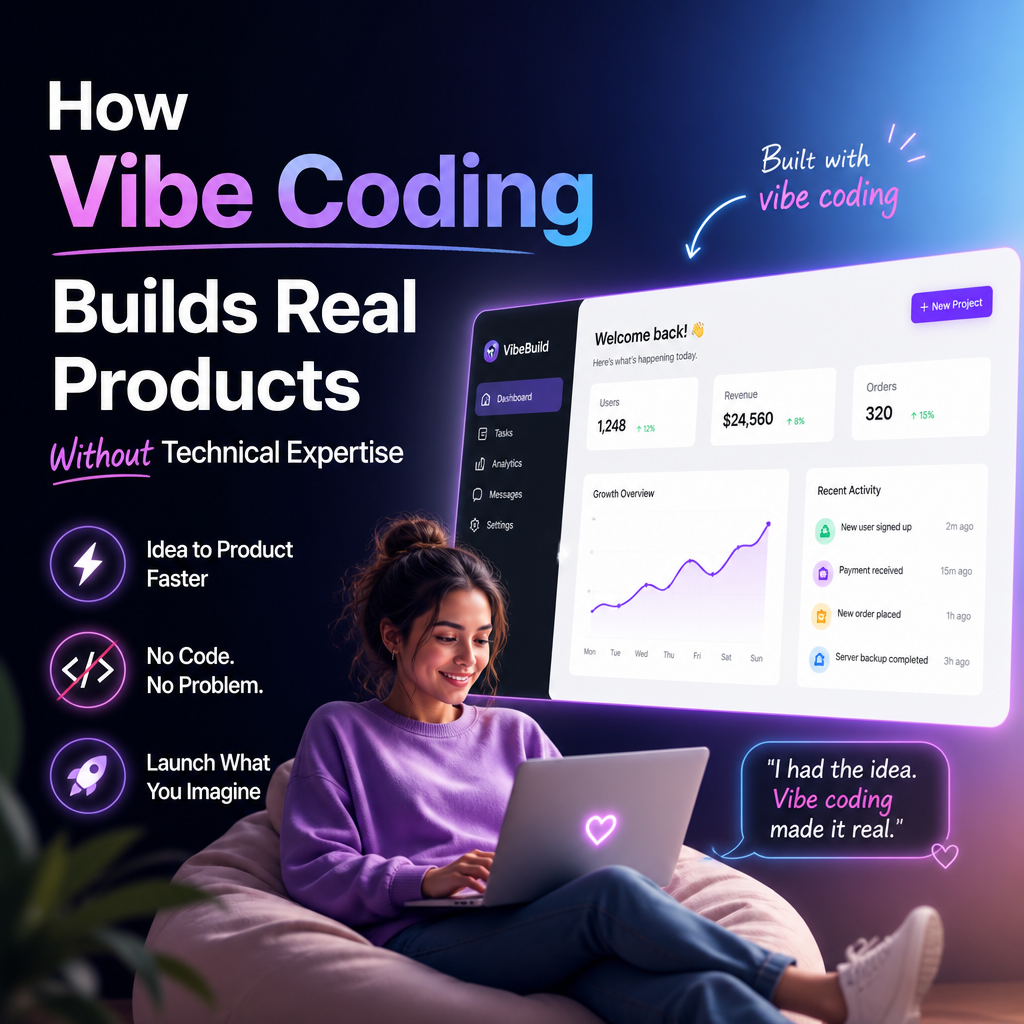
How Vibe Coding Builds Real Products Without Technical Expertise
The Future of Vibe Coding: Building Real Products Without Technical Expertise
For years, turning an idea into software meant learning to code, hiring developers, or finding a technical co-founder. Vibe coding is changing that equation. By describing what they want in everyday language, people can use AI tools to generate code, build interfaces, and create working prototypes—often without traditional programming experience.
The term captures a new style of development: focus on the product’s purpose and feel, then collaborate with AI to make it real. It does not mean technical knowledge is irrelevant. Instead, it shifts where that knowledge is needed and opens the door for more people to participate in building software.

What Vibe Coding Makes Possible
AI coding tools can turn a plain-language prompt into a basic website, app, or automation. A founder might describe a booking platform, while a teacher could request a classroom quiz tool. The AI can draft the interface and underlying code, then revise it in response to feedback.
This makes early experimentation faster and less expensive. Instead of spending weeks building an idea before testing it, a nontechnical creator can produce a prototype, show it to potential users, and learn what needs to change.

Vibe coding can also help with tasks beyond writing code. Depending on the tools involved, creators may be able to:

- Generate layouts, forms, and common app features
- Connect a product to databases or third-party services
- Identify and fix straightforward errors
- Update copy, styling, and functionality through conversation
These capabilities make software creation more accessible, especially for simple products and early versions of more ambitious ideas.
From Prototype to Product
A working demo is not the same as a dependable product. A prototype may look convincing while lacking essential safeguards, such as secure user accounts, reliable data storage, accessibility, or clear error handling.
That distinction matters as creators move from experimentation to real-world use. Products that handle payments, health information, personal data, or business operations need careful testing and appropriate security measures. AI-generated code can contain mistakes, and a creator may not immediately recognize the risks.
The most promising approach is to treat AI as a capable collaborator—not an unquestionable authority. Ask it to explain important decisions, review changes, and identify potential weaknesses. Test the product with realistic examples, and involve an experienced developer when the project’s complexity or risk warrants it.
What Nontechnical Creators Still Need
Vibe coding lowers the barrier to making software, but successful products still depend on good judgment. People building with AI benefit from understanding the problem they are solving, the needs of their users, and the limits of the tools they use.
A practical workflow can help:
- Start with a clear problem. Define who the product serves and what it should help them do.
- Build the smallest useful version. Focus on a few essential features instead of attempting a complete platform.
- Test early and often. Try common tasks, edge cases, and confusing situations.
- Protect user data. Avoid collecting information the product does not need, and check how it is stored.
- Get expert help when needed. Security, infrastructure, and complex integrations may require professional review.
These steps are valuable whether a creator writes code manually or guides an AI tool to produce it.
The Future of Vibe Coding
As AI development tools improve, the process is likely to become more visual, conversational, and integrated. Creators may describe a product, watch the system generate it, and refine its behavior through natural language. Tools may also become better at explaining code, detecting bugs, and testing changes automatically.
That could reshape who gets to build digital products. Small businesses may create tools tailored to their workflows. Community organizations may launch useful services without large budgets. Entrepreneurs may test more ideas before deciding which ones deserve major investment.
At the same time, access alone will not guarantee quality. Good products still require thoughtful design, user feedback, and responsible handling of data. The people who benefit most from vibe coding may be those who combine clear goals with curiosity and a willingness to check the AI’s work.
Vibe coding is not a future where technical expertise disappears. It is a future where fewer people need to begin as programmers to make their ideas tangible. With the right tools and realistic expectations, nontechnical creators can move from describing a product to building something people can actually use.