AI Agents vs Traditional Software: Key Differences and Use Cases
AI Agents vs Traditional Software: What’s the Difference?
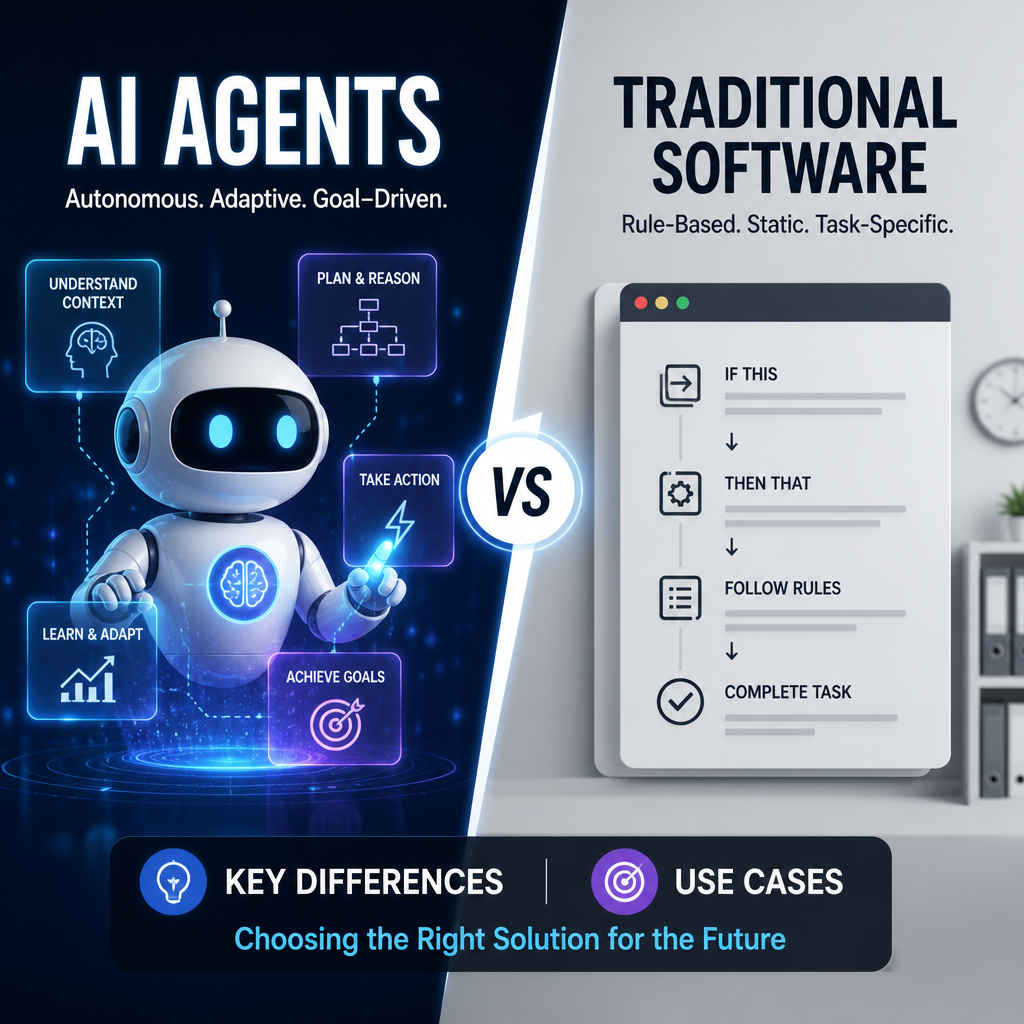
Traditional software and AI agents can both help people complete tasks, but they work in different ways. Traditional software follows rules and instructions defined in advance. An AI agent can use a goal, available tools, and new information to decide what to do next.
Understanding the difference between AI agents vs traditional software can help businesses choose the right approach. In many cases, the best solution combines both.

How Traditional Software Works
Traditional software is built around predictable inputs and outputs. Developers define the logic, and the program follows it whenever it runs.
For example, an online store might use fixed rules to calculate shipping costs. If a package weighs less than a certain amount and is sent to a specific region, the software applies the corresponding rate. The same inputs generally produce the same result.

This approach is useful when a task is clearly defined and needs to be completed consistently. Traditional software is often:

- Reliable: It follows established rules.
- Fast: It can process routine tasks efficiently.
- Predictable: Its behavior is easier to test and explain.
- Controlled: Developers can specify exactly what actions it may perform.
However, traditional programs may struggle with ambiguity or unexpected situations. When an input falls outside the rules developers anticipated, the software may return an error or require a person to step in.
How AI Agents Work
An AI agent is a system that can interpret a goal, gather information, and take actions toward completing that goal. Depending on its design, it may use language models, databases, web services, or other software tools.
Suppose a customer asks an agent to find an order, check its delivery status, and explain why it is delayed. The agent may identify the request, look up the order, review tracking information, and compose a response. If it lacks access to one of those systems, it may need to ask a follow-up question or refer the issue to a person.
Unlike a fixed workflow, an agent may choose among different steps as circumstances change. This flexibility can make it useful for tasks that involve natural language, varied information, or several tools.
That flexibility also introduces uncertainty. An agent can misunderstand a request, rely on incorrect information, or take an inappropriate action if it has too much access or too few safeguards.
AI Agents vs Traditional Software: Key Differences
Rules Versus Goals
Traditional software generally executes rules written by developers. An AI agent is usually given a goal and determines how to pursue it within its instructions and permissions.
A rule-based system might automatically route a support ticket based on a selected category. An agent could interpret the ticket’s wording, identify its likely topic, and decide whether to search a knowledge base or pass it to a specialist.
Predictability Versus Adaptability
Traditional software is usually easier to predict because its logic is explicit. AI agents can adapt to varied requests, but their responses may differ even when the requests are similar.
This makes conventional software a strong fit for precise calculations and compliance-critical processes. Agents may be more helpful when inputs are unstructured, such as emails, documents, or conversational questions.
Fixed Workflows Versus Flexible Steps
A traditional workflow follows a predetermined sequence. An agent can sometimes select different tools or actions depending on what it learns along the way.
For example, a fixed system may require a user to complete a form before processing a refund. An agent might review a conversation and order history first, then recommend the appropriate next step. Whether it should issue the refund itself depends on the organization’s policies and safeguards.
When to Use Each Approach
Traditional software is often the better choice when a task needs consistent, auditable results and follows clear rules. Examples include payroll calculations, inventory updates, and payment processing.
AI agents may be useful when work involves interpreting language, gathering information from multiple sources, or handling requests that vary from case to case. Examples include drafting a response from a support record or summarizing research for an employee.
Before deploying an agent, organizations should consider:
- Which systems and information it can access
- What actions it is permitted to take
- When a person must review its work
- How its performance and errors will be monitored
Why Many Systems Combine Both
The choice is not always AI agents or traditional software. A practical system can use an agent for interpretation and a conventional program for actions that require precision.
For instance, an agent might read a customer’s request and identify the relevant account. Traditional software can then apply fixed eligibility rules before approving a change. This combination can offer flexibility without leaving important decisions entirely to a generative model.
Choosing the Right Tool
AI agents vs traditional software is not a contest with one universal winner. Traditional software excels at repeatable tasks with clear rules. AI agents can add value when a system needs to interpret context and work through less structured requests.
The right choice depends on the task, the consequences of mistakes, and the level of human oversight available. By matching each tool to the work it does best, organizations can build systems that are both useful and dependable.